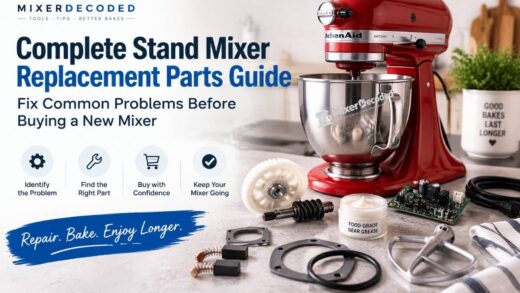
A stand mixer that stops working, makes a strange noise, or won’t behave the way it should is rarely a reason to panic. Most problems trace back to a small, predictable set of causes, and the majority can be fixed in minutes without a repair technician.
This guide is built to work across brands, not just one. Whether you own a KitchenAid, Bosch, Ankarsrum, Cuisinart, or another stand mixer, the underlying mechanics behind most symptoms, motor strain, clearance adjustment, thermal protection, worn components, are similar across the category. Where a specific step reflects a common convention, such as the dime test or certain terminology, we note it, since not every brand implements every mechanism identically.
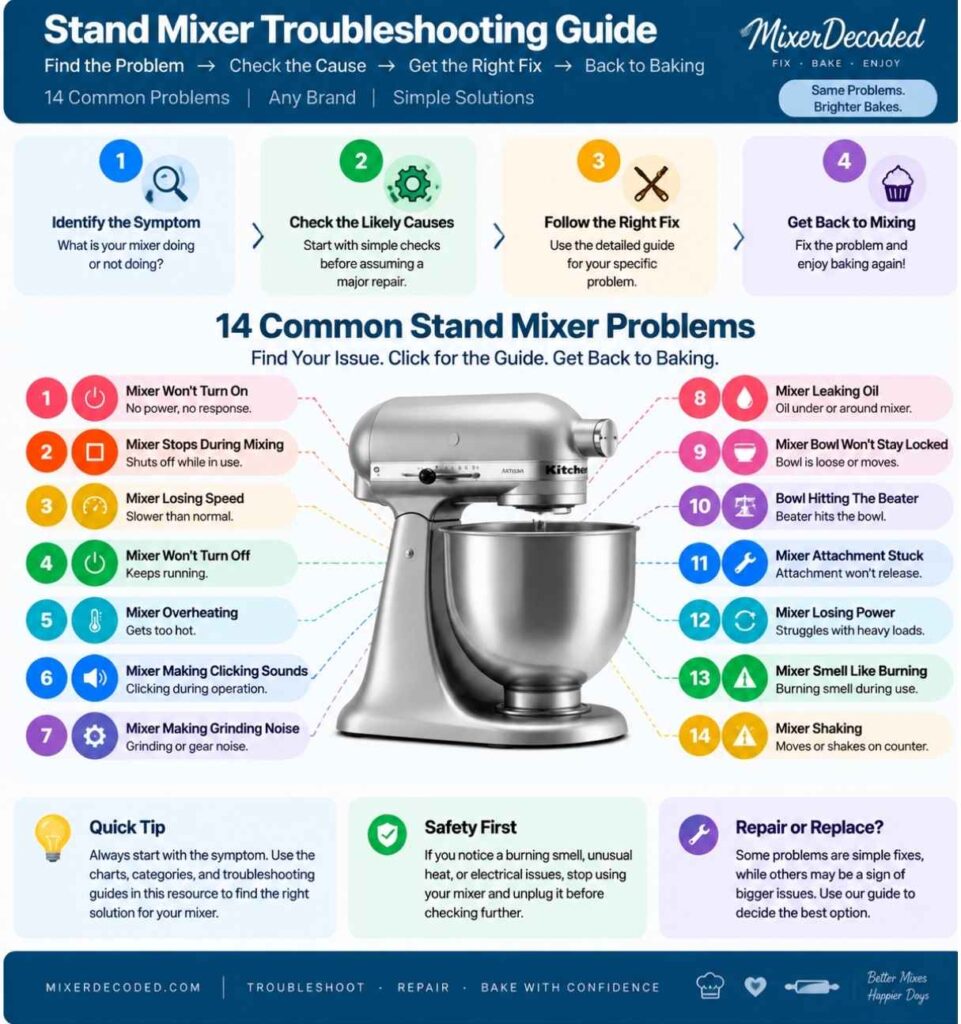
Use the quick-reference chart below to find your exact symptom, or browse by category if you’re not sure yet what’s actually wrong.
In this article, we’ll cover:
Start Here: Before You Diagnose Anything
Before working through any specific symptom, rule out the basics. These four checks resolve a surprising number of “broken” mixers in under five minutes:
- Confirm the mixer is getting power. Plug it directly into a wall outlet you’ve confirmed is live, not a power strip or extension cord.
- Check the bowl and head position. Nearly all stand mixers have a safety interlock that prevents the motor from running unless the bowl (bowl-lift models) or head (tilt-head models) is fully locked into position.
- Confirm the attachment is fully seated. A beater, whisk, or dough hook that isn’t fully locked into the hub can cause a range of symptoms, from failure to start to noise to poor mixing.
- Let it cool if it was just run hard. Most mixers have thermal overload protection that temporarily shuts the motor down after heavy use. If your mixer just stopped after mixing stiff dough, this is often the explanation before anything else.
⚙️ A Note on Tilt-Head vs. Bowl-Lift Design
Stand mixers generally come in two main designs. Understanding which type you own can help you diagnose problems correctly because the locking system, bowl position, and adjustment points can differ.
Tilt-Head Mixers
Tilt-head mixers have a motor head that tilts upward to give access to the bowl and attachment area.
• Head locked correctly
• Bowl position
• Attachment clearance
Bowl-Lift Mixers
Bowl-lift mixers keep the motor head fixed while the bowl moves upward into position using support arms.
• Bowl lift position
• Support arms
• Bowl stability
The same symptom can have different causes depending on whether your mixer uses a tilt-head or bowl-lift design. Always identify your mixer type before adjusting or troubleshooting.
Quick-Reference Symptom Chart
Match what you’re noticing to the most likely cause and the article with the full fix.
| 🔎 Symptom | ⚠️ Possible Cause | 🛠 First Check |
|---|---|---|
| ⚡ Stand Mixer Won’t Turn On | Power supply, switch, electrical, or motor starting problems. | Check the outlet, power connection, and basic settings. |
| ⏹️ Mixer Stops During Mixing | Overload protection, overheating, or workload-related issues. | Reduce the load and check operating conditions. |
| 🎚️ Mixer Losing Speed | Speed control, motor performance, or internal wear issues. | Check speed response and operating conditions. |
| ⛔ Mixer Won’t Turn Off | Control switch, linkage, or electrical control problems. | Disconnect power and inspect the control operation. |
| 🌡️ Mixer Overheating | Heat buildup, workload, or motor protection activation. | Allow cooling and review operating conditions. |
| 🔊 Mixer Making Clicking Sounds | Mechanical wear or internal component issues. | Identify when and where the clicking occurs. |
| ⚙️ Mixer Making Grinding Noise | Gear, motor, or mechanical problems. | Stop operation and identify the noise source. |
| 🛢️ Mixer Leaking Oil | Lubrication or internal seal-related problems. | Check the source and amount of leakage. |
| 🥣 Mixer Bowl Won’t Stay Locked | Bowl positioning, locking points, or support issues. | Reseat the bowl and check the locking area. |
| 🥣 Bowl Hitting The Beater | Clearance, bowl position, or adjustment problems. | Check the beater-to-bowl clearance. |
| ⚠️ Mixer Shaking | Stability, bowl, attachment, or mechanical movement issues. | Check setup and secure all parts. |
| 🔧 Mixer Attachment Stuck | Attachment fitting or removal problems. | Check attachment connection and removal method. |
| ⚠️ Mixer Losing Power | Loses Power Suddenly, Slow At All Speeds, or Gets Weaker Over Time. | Test the power connection and Stop using and inspect further. |
| ⚠️ Mixer Smell Like Burning | Smell from a brand-new mixer, Hot electrical or plastic smell, or Burning smell during heavy mixing. | Use briefly and monitor if it disappears and Stop using and inspect the source. |
Browse Mixer Problems by Category
Find your mixer problem by category and go directly to the troubleshooting guide that matches your issue.
The 14 Mixer Problems and Fixes
Every stand mixer problem has a starting point. This guide covers 14 of the most common issues that affect stand mixers, from power and motor problems to bowl, attachment, noise, and performance issues.
Choose the symptom that matches what your mixer is experiencing to find the right troubleshooting steps and solution.
Mixer Won’t Turn On
Troubleshoot power, switch, and starting problems.
Mixer Stops During Mixing
Find causes related to stopping during operation.
Mixer Losing Speed
Troubleshoot speed changes and performance issues.
Mixer Won’t Turn Off
Identify control and switching problems.
Mixer Overheating
Understand heat-related shutdown and protection issues.
Mixer Making Clicking Sounds
Find possible causes of clicking noises.
Mixer Making Grinding Noise
Troubleshoot grinding and mechanical sounds.
Mixer Leaking Oil
Identify oil leakage causes and next steps.
Mixer Bowl Won’t Stay Locked
Troubleshoot bowl locking and stability problems.
Bowl Hitting The Beater
Check bowl position and clearance issues.
Mixer Attachment Stuck
Find causes of attachment removal problems.
Mixer Shaking
Troubleshoot unwanted movement during mixing.
Mixer Losing Power
Identify Lose of Power and stability problems.
Mixer Smell Like Burning
Stop using and identify the source.
When to Repair vs. When to Replace
Not every mixer problem means you need a new appliance. Some issues can be solved with simple adjustments or replacement parts, while others may make repair less practical. Use the guide below to decide whether repairing your stand mixer is the better option.
Repair Your Mixer When…
- The problem is caused by a replaceable part or adjustment
- The mixer still has good overall performance
- The repair cost is reasonable compared with replacement
- The issue is isolated to one specific component
- The mixer is otherwise in good condition
Consider Replacement When…
- Multiple major problems are happening at the same time
- The motor or internal components have serious damage
- Repair costs approach the price of a new mixer
- The mixer repeatedly develops the same failures
- Replacement parts are difficult to find
Start by identifying the exact problem first. A mixer with a single repairable issue may still have many years of useful service left.
Frequently Asked Questions
Stand mixer problems can come from different areas, including power, controls, mechanical parts, attachments, and normal operating conditions. These answers cover common questions users ask when diagnosing a mixer problem and deciding on the right next step.
Why is my stand mixer not working?
A stand mixer can stop working because of several issues, including power problems, overload protection, electrical faults, control problems, or mechanical failures. Start by identifying the exact symptom your mixer is showing before choosing a troubleshooting path.
How do I know what is wrong with my stand mixer?
The best way to diagnose a stand mixer problem is to match the symptom with the likely cause. Check whether the issue involves power, stopping during use, unusual sounds, bowl movement, attachments, speed, or overheating.
Can most stand mixer problems be fixed at home?
Many common stand mixer issues can be checked with basic troubleshooting steps, such as checking connections, cleaning, adjusting parts, or confirming correct setup. More serious mechanical or electrical problems may require further inspection.
Why does my stand mixer make strange noises?
Unusual sounds can come from different sources, including mechanical wear, internal components, gears, or other moving parts. Identifying when the sound happens and where it comes from helps narrow down the cause.
Is it worth repairing a stand mixer?
Whether repair is worthwhile depends on the type of problem, the condition of the mixer, repair cost, and availability of replacement parts. A single repairable issue may be worth fixing, while repeated major failures may make replacement a better option.
Why does my mixer bowl keep moving or coming loose?
A bowl that does not stay secure may be caused by incorrect positioning, worn locking areas, or problems with the bowl support mechanism. The bowl should always be properly secured before operating the mixer.
Final Thoughts: Stand Mixer Troubleshooting Guide
A stand mixer problem is easier to solve when you start with the symptom instead of guessing at the cause. A mixer that will not turn on requires a different approach from one that stops during mixing, makes unusual sounds, loses speed, or has bowl and attachment problems.
Before replacing your mixer, work through the basic checks, identify the type of issue you are dealing with, and follow the troubleshooting steps that match your specific symptom. Many problems come down to setup, adjustments, worn components, or individual parts that can be repaired or replaced.
Use the troubleshooting guides in this resource to find the exact problem your mixer is showing, understand the likely causes, and decide the right next step.
Start With The Symptom, Not The Guess
Identify what your mixer is doing, follow the matching troubleshooting guide, and choose the repair path that fits the actual problem.
Full Troubleshooting Index
Browse the complete collection of stand mixer troubleshooting guides below. Each guide focuses on a specific problem, helping you identify the cause, follow the right checks, and find the best solution for your mixer.
This guide is maintained and updated as new causes are identified and validated. If you don’t see your exact symptom above, the closest matching category is usually the right place to start.
Last Updated on September 5, 2026 by Susan Joy