Ooni Halo Core spiral mixer review: The Ooni Halo Core is a compact spiral mixer designed for home bakers who regularly make pizza dough, sourdough, and other yeasted breads. Unlike a conventional planetary stand mixer, it combines a rotating bowl with a spiral dough hook and breaker bar. It also includes separate tools for beating and whipping, so it is not limited to kneading dough.
The key question is whether that dough-focused design justifies choosing the Halo Core over a conventional stand mixer or spending more on a larger spiral mixer. Its 4.8-quart bowl and 5.5-pound maximum dough capacity put it in a different category from larger machines, making batch size and baking habits central to the decision.
This review examines the Halo Core’s published specifications, mixing design, capacity, included tools, limitations, and alternatives.
Ooni Halo Core: At a Glance
| Feature | Details |
|---|---|
| Mixer type | Spiral mixer |
| Bowl capacity | 4.8 qt / 4.5 L |
| Maximum dough capacity | 5.5 lb / 2.5 kg, according to Ooni’s current U.S. product specifications |
| Motor | Dual DC motors |
| Rated power | 300 W |
| Speed settings | 20 |
| Bowl material | Stainless steel |
| Product weight | 23.2 lb |
| Dimensions | 16.18 × 8.86 × 12.28 in |
| Included mixing tools | Spiral dough hook and breaker bar, angled silicone-edge beater, dual-geared whisk |
| Standard warranty | 1 year; Ooni advertises an extension to 5 years with registration, subject to its terms |
Reviewed by the MixerDecoded Editorial Team
Research, specifications, and product claims are checked against manufacturer documentation and independent sources. Hands-on testing findings are identified separately where applicable. See our Review Process →
Ooni Halo Core Spiral Mixer
Compact Spiral Mixer for Home Bakers
A dough-focused spiral mixer designed for home pizza makers and bread bakers, with additional attachments for beating and whipping.
Pros
- Dough-focused spiral mixing design
- Compact alternative to the larger Halo Pro
- Includes tools for dough, beating, and whipping
- 20 speed settings
Cons
- Lower capacity than the Ooni Halo Pro
- Specialized design may be unnecessary for occasional dough makers
- Premium purchase price
- Not independently hands-on tested by MixerDecoded
Maximum dough capacity is based on Ooni’s published specifications. Verify the exact listing and package contents before purchasing.
As an Amazon Associate, MixerDecoded may earn from qualifying purchases.
In this article, we’ll cover:
What Is the Ooni Halo Core?

The Ooni Halo Core is a countertop spiral mixer aimed at home bakers who want a machine designed around dough development. Ooni introduced it in July 2026, with U.S. availability announced for August 4, 2026.
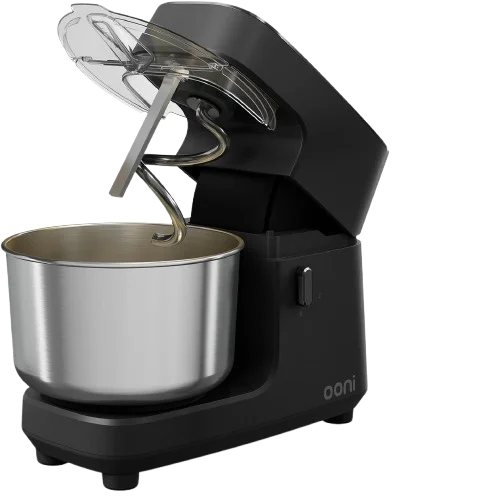
Its defining feature is the way the bowl and hook work together. The bowl rotates while the spiral hook works the dough against a removable breaker bar. This differs from the planetary mixing action used by common stand mixers, where an attachment moves around a stationary bowl.
That distinction matters most to people who regularly prepare pizza dough, sourdough, and other bread doughs. It does not automatically mean a spiral mixer is the best choice for every home baker. The right machine depends on what you make, the batch sizes you need, and how often you bake.
Spiral Mixing Design: Why It Matters for Dough
Ooni’s spiral-mixing system uses three main components: a rotating stainless-steel bowl, a spiral dough hook, and a removable breaker bar. Together, they work the dough through a repeated mixing and kneading action.
The design is intended to develop dough while limiting unnecessary heating during mixing. That is relevant to pizza makers and bread bakers who want repeatable dough preparation, particularly when making batches regularly.
However, the mechanism alone cannot guarantee better bread or pizza. Results also depend on the flour, hydration, recipe, dough temperature, fermentation schedule, and mixing technique.
Is a spiral mixer better than a planetary stand mixer?
Not for every task.
A spiral mixer is worth considering when dough is a major part of your baking routine. A conventional planetary stand mixer may be more practical if your main tasks are cakes, cookies, buttercream, occasional bread, and general kitchen mixing.
The Halo Core attempts to bridge those uses with its included beater and whisk. Even so, buyers should compare the tools, bowl size, minimum batch requirements, and intended workloads of each model rather than treating the mixer type as the only deciding factor.
Capacity: Is the 4.8-Quart Bowl Big Enough?
The Halo Core has a 4.8-quart (4.5 L) stainless-steel bowl. Ooni lists a maximum dough capacity of 2.5 kg (5.5 lb) and says that amount can make approximately ten 12-inch pizza bases or three sourdough loaves.
For home bakers, the more useful question is how that capacity compares with their normal batch size. A machine’s maximum capacity does not mean every recipe will mix well at that amount, and the ideal batch size can vary with dough hydration and formulation.
The published specifications also list a minimum dough quantity of 500 g. That is worth noting if you often make very small batches: a mixer designed around dough may not be the best fit for every small mixing task.
The Halo Core is most compelling when your usual dough batches fit comfortably within its stated operating range. If you regularly make larger batches for gatherings, frequent baking, or multiple loaves at once, compare its capacity with larger machines before deciding.
Pizza Dough, Sourdough, and Bread
Ooni Halo Core for pizza dough
Pizza dough is a natural use case for a spiral mixer. The rotating bowl and spiral hook are designed to work dough together, and the published maximum capacity gives home pizza makers a reference point for planning batches.
Ooni says the Halo Core can mix enough dough for about ten 12-inch pizza bases at its stated maximum capacity. Actual yield depends on the dough-ball weight in your recipe. If you normally make only two or three pizzas, consider whether you will benefit from this design enough to justify dedicating counter space and budget to it.
Ooni Halo Core for sourdough
The Halo Core may interest sourdough bakers who want to mix dough mechanically rather than knead by hand. Its listed capacity accommodates a batch that Ooni equates to approximately three sourdough loaves.
Mixing is only one part of sourdough baking, though. Starter activity, fermentation, dough handling, shaping, and baking conditions remain important. A spiral mixer does not remove the need to understand those stages.
Ooni Halo Core for bread
For regular bread making, evaluate the Halo Core against your actual recipes. Consider the dough weight, hydration, enrichment, frequency of use, and whether you tend to bake one loaf or several at a time.
If bread and dough are your primary reasons for buying a mixer, compare the Halo Core with the Ooni Halo Pro and other dough-focused options. The larger machine may be worth investigating if your normal batches exceed the Halo Core’s stated capacity.
Included Attachments and Everyday Mixing
Ooni lists three main attachments or attachment systems for the Halo Core:
- Spiral dough hook and removable breaker bar: intended for mixing and kneading dough.
- Angled silicone-edge beater: designed for tasks such as creaming ingredients and mixing batters.
- Dual-geared whisk: intended for whipping tasks such as cream and meringue.
The product also includes a removable stainless-steel bowl and a splash guard. The bowl and removable attachments are dishwasher-safe, with an important exception: the dual-geared whisk’s gearbox should be wiped clean rather than submerged.
This range of tools makes the Halo Core more versatile than a dough-only machine. Still, buyers should not assume it will duplicate every function or attachment option offered by a familiar planetary stand mixer. Check the included tools and care instructions in the exact product package before buying.
Size, Weight, and Counter Space
The Ooni Halo Core is approximately 16.18 inches long, 8.86 inches wide, and 12.28 inches high, with an unboxed weight of 23.2 pounds.
Those measurements make it relatively compact compared with many larger stand mixers, but it is not weightless or especially small in every kitchen. Measure your intended counter area and check the clearance under overhead cabinets before purchasing. Also consider whether you want to leave it out permanently or move it into storage between uses.
The Ooni Halo Core is 25% smaller and 30% lighter than the Halo Pro. You need to also check the individual machines’ dimensions and weights if storage space is a deciding factor.
Pros and Cons
Potential advantages
- Dough-focused design: The rotating bowl, spiral hook, and breaker bar are intended for mixing and kneading dough.
- Useful stated capacity: The maximum listed dough load is 5.5 lb, suitable for some multi-pizza and multi-loaf batches.
- Multiple mixing tools: The beater and whisk extend its uses beyond dough.
- Compact relative to the Halo Pro: Its published footprint and weight are lower than those of its larger sibling.
- Variable speed control: Twenty speed levels give users more adjustment options than a simple few-speed control.
Potential drawbacks
- Capacity has limits: Its maximum dough capacity is lower than that of the Halo Pro.
- Specialized design: Buyers who mainly make cakes, cookies, and small everyday recipes may prefer a conventional planetary stand mixer.
- Significant purchase cost: Interested buyers should compare the cost with their actual baking needs and alternatives.
- Not a substitute for technique: Mixing design alone cannot guarantee a particular dough or baking result.
- Real-world performance needs testing: This review does not claim to have independently tested noise, mixing consistency, durability, or results across recipes.
Ooni Halo Core vs. Ooni Halo Pro

The Halo Core is the smaller model in Ooni’s spiral-mixer range. The Halo Pro has a larger 7.3-quart (7 L) bowl and a higher stated dough capacity, making it a more relevant comparison for people who regularly prepare larger batches.
| Consideration | Ooni Halo Core | Ooni Halo Pro |
|---|---|---|
| Bowl capacity | 4.8 qt / 4.5 L | 7.3 qt / 7 L |
| Maximum dough capacity | 5.5 lb / 2.5 kg | 11 lb / 5 kg |
| Intended appeal | More compact dough-focused mixer | Larger-capacity spiral mixer |
| Best comparison question | Will its capacity cover your normal batches? | Do you regularly need more dough capacity? |
Choose the Halo Core if its capacity fits your typical recipes and its smaller footprint is valuable. Investigate the Halo Pro if your normal dough batches are larger or you want more room to scale. For a deeper comparison, see Ooni Halo Pro review.
Ooni Halo Core vs. KitchenAid

The Halo Core and a KitchenAid planetary stand mixer are built around different mixing mechanisms. The Halo Core emphasizes spiral mixing; KitchenAid’s familiar tilt-head and bowl-lift models use planetary action and offer a broad optional-attachment ecosystem.
The better choice depends on what you make most often.
Consider the Halo Core if you regularly mix pizza or bread dough and specifically want a spiral-mixing design. Consider a KitchenAid if your work is more varied (cakes, cookies, frosting, occasional dough) and you value its model range and optional attachments.
Do not compare the Halo Core’s bowl capacity directly with a KitchenAid bowl as if the numbers alone establish performance. Bowl volume, maximum dough load, minimum batch size, attachment design, and intended workload all matter.
If you want to choose other conventional stand mixers, see Best Stand Mixers guide.
Is the Ooni Halo Core Worth It?
The Ooni Halo Core is worth considering if dough mixing is a central part of your home baking and your typical batches fit within its stated 5.5-pound maximum. Its spiral mechanism, rotating stainless-steel bowl, and dedicated dough hook and breaker bar give it a clear identity beyond a conventional stand mixer.
It is a less obvious choice for someone who mainly bakes cookies and cakes, makes very small batches, or rarely prepares dough. Those buyers may get better value from a conventional stand mixer that matches their everyday tasks.
Our provisional verdict: The Halo Core is a promising option for home bakers who want a compact, dough-focused spiral mixer. Whether it is the right purchase depends on batch size, baking frequency, counter space, and whether spiral mixing is worth prioritizing over broader stand-mixer versatility.
Frequently Asked Questions
What size bowl does the Ooni Halo Core have?
Ooni lists a 4.8-quart (4.5 L) stainless-steel bowl.
How much dough can the Ooni Halo Core mix?
Ooni’s current U.S. product specifications list a maximum dough capacity of 2.5 kg (5.5 lb). The company equates that quantity to roughly ten 12-inch pizza bases or three sourdough loaves, depending on recipe and portion size.
Is the Ooni Halo Core good for pizza dough?
Its spiral-mixing mechanism is designed for dough, making pizza dough a relevant use case. The suitability of the mixer depends on your usual batch size and recipe.
Can the Ooni Halo Core make sourdough?
Ooni lists bread and sourdough among the machine’s intended uses and says its maximum batch can make approximately three sourdough loaves. Your recipe, dough weight, and fermentation process will affect the result.
Can the Ooni Halo Core mix cakes and cookies?
It includes an angled silicone-edge beater for everyday mixing tasks and a dual-geared whisk for whipping. It therefore offers uses beyond kneading dough, although it has a different mechanism from a conventional planetary stand mixer.
Is the Ooni Halo Core smaller than the Halo Pro?
Yes. Ooni describes the Halo Core as 25% smaller and 30% lighter than the Halo Pro. Compare the published dimensions and weight of both models if storage and counter space are important.
What is the warranty on the Ooni Halo Core?
Ooni’s U.S. getting-started page states a one-year standard warranty and advertises an extension to five years with registration, subject to the applicable terms. Review the current warranty conditions before buying.
Is the Ooni Halo Core better than a KitchenAid stand mixer?
Neither is automatically better for every user. The Halo Core is designed around spiral mixing for dough, while KitchenAid planetary mixers are available in multiple capacities and support a wide optional-attachment ecosystem. Choose based on the recipes you make most often, batch sizes, and the functions you need.
Final Verdict about the Ooni Halo Core Spiral Mixer review
The Ooni Halo Core fills a specific role: a more compact spiral mixer for home bakers who want to prioritize pizza dough, sourdough, and bread without stepping up to the Halo Pro’s larger bowl and capacity.
Its strongest case is for a baker whose regular dough batches fit within the manufacturer’s stated limit and who values spiral mixing enough to justify the cost. If you mostly bake cakes and cookies or only knead dough occasionally, compare conventional stand mixers before deciding.
Before buying, verify the current price, warranty terms, and whether the Halo Core’s capacity matches your recipes. For a broader shortlist, return to our Best Stand Mixers guide.
Last Updated on October 14, 2026 by Susan Joy