Knowing and choosing between a tilt-head vs bowl-lift stand mixers comes down to how you bake, how much you mix at once, and how much space you have in your kitchen. A tilt-head mixer makes the bowl easier to access by raising the motor head, while a bowl-lift mixer keeps the head stationary and raises the bowl into mixing position.
Neither design is automatically better. A tilt-head model can be a practical choice for everyday household baking, while a bowl-lift model may suit larger batches or more demanding workloads provided its specifications match your needs.
To make the difference concrete, this guide compares the two designs and uses the KitchenAid Artisan KSM150PS and KitchenAid Commercial KSM8990WH as examples. These are a 5-quart household tilt-head mixer and an 8-quart commercial bowl-lift mixer, respectively. Because they differ in more than their head mechanisms, they should be treated as examples of two buying priorities, not as a controlled test of the two designs.
Tilt-Head vs Bowl-Lift: Quick Comparison
| Feature | Tilt-head mixer | Bowl-lift mixer |
|---|---|---|
| How it works | The motor head tilts back to expose the bowl | A lever raises or lowers the bowl beneath a fixed head |
| Bowl access | Raise the head to access the bowl and mixing tool | Lower the bowl to access ingredients and remove the bowl |
| Changing mixing tools | Usually requires raising the head | Usually requires lowering the bowl and removing the tool |
| Overhead clearance | Needs room for the head to tilt back | Needs enough room to operate the mixer and handle the bowl |
| Capacity | Varies by model | Varies by model; some models offer larger bowls |
| Best buying consideration | Convenient access and everyday versatility | Capacity, bowl support, and the model’s intended workload |
| Main limitation | Head clearance and model-specific batch limits | Bowl handling, footprint, and the suitability of a larger mixer for your batches |
These are general design differences, not universal performance rankings. Bowl capacity, motor specifications, workload limits, and included tools vary by model.
STAND MIXER COMPARISON
Tilt-Head vs. Bowl-Lift: Compare Two KitchenAid Mixers
Compare a household tilt-head mixer with a larger-capacity commercial bowl-lift model before deciding which suits your baking.
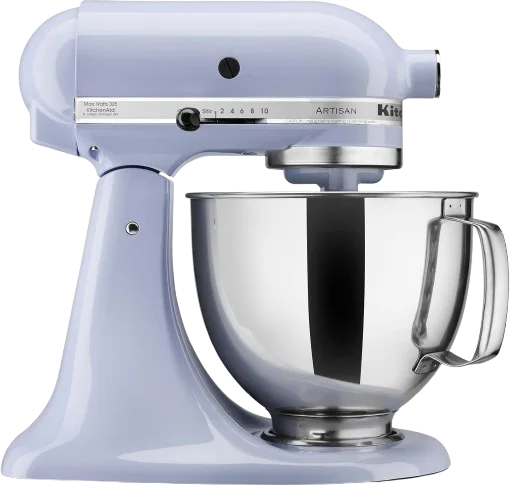
KitchenAid Artisan KSM150PS
5-quart bowl
A household stand mixer to consider for everyday baking, including cakes, cookies, frosting, and suitable dough recipes.
- Tilting head for bowl access
- 10-speed control
- Household baking focus
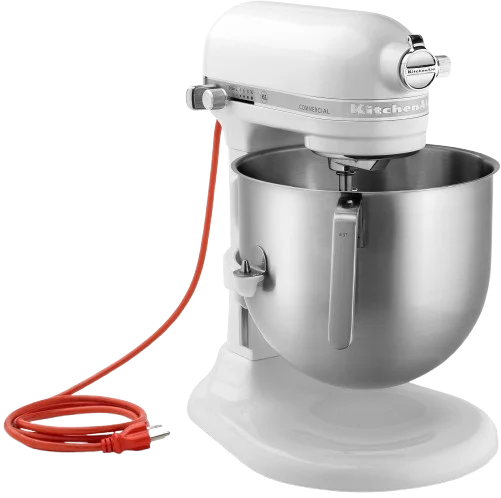
KitchenAid Commercial KSM8990WH
8-quart bowl
A larger-capacity mixer with manufacturer-documented commercial-use features for users whose workload justifies it.
- Lever-operated bowl lift
- Fixed motor head
- NSF-certified commercial-use model
As an Amazon Associate, MixerDecoded earns from qualifying purchases.
In this article, we’ll cover:
What Is a Tilt-Head Stand Mixer?
A tilt-head stand mixer has a motor head that pivots upward, exposing the bowl and mixing attachment. After adding ingredients or changing tools, you lower and lock the head before mixing.
This arrangement is common in household stand mixers. For example, the KitchenAid Artisan KSM150PS has a 5-quart stainless-steel bowl and 10 speeds. KitchenAid lists a coated flat beater, coated dough hook, wire whip, and pouring shield among its included accessories. Check the exact listing for the finish and bundle you intend to buy.
Advantages of tilt-head mixers
Convenient bowl access. Raising the head gives you direct access to the bowl when adding ingredients, scraping the sides, or changing mixing tools.
Practical for everyday baking. A suitable tilt-head model can handle a range of household tasks, including cake batter, cookie dough, frosting, whipped cream, and manufacturer-approved yeast dough.
A straightforward design. You do not need to raise and lower the bowl on support arms to access the mixing area.
Disadvantages of tilt-head mixers
Overhead clearance matters. You need enough room above the mixer to raise the head. A model that fits beneath your cabinets when closed may not be convenient to use in that location.
Capacity is model-specific. A 5-quart bowl may be sufficient for many household recipes but may not meet the needs of someone who regularly prepares large batches.
Dough limits still apply. A tilt-head design does not mean the mixer can handle every stiff dough or batch size. Follow the exact model’s instructions for dough type, quantity, and speed.
Who should choose a tilt-head mixer?
Consider a tilt-head model if you mainly make cakes, cookies, frosting, and occasional bread or pizza dough. It may also suit you if you value easy access to the bowl and do not regularly mix large quantities.
For a closer look at one example, read our KitchenAid Artisan review.
What Is a Bowl-Lift Stand Mixer?
A bowl-lift stand mixer keeps its motor head in place while a lever raises the bowl into mixing position. Lowering the bowl provides access for adding ingredients and removing the bowl.
KitchenAid’s Commercial KSM8990WH is an 8-quart bowl-lift model with NSF commercial-use certification. KitchenAid describes its bowl-lift structure as providing support during mixing and its high-efficiency DC motor as designed for longer mixing, kneading, and whipping tasks.
These are manufacturer-described features, not independent comparative test results.
Advantages of bowl-lift mixers
Larger-bowl options. Some bowl-lift models have larger bowls than many household tilt-head mixers. The KSM8990WH, for example, has an 8-quart bowl.
A fixed motor head. The head stays in position while the bowl is raised or lowered, so you do not need to tilt the motor housing back to access the mixing area.
Models designed for demanding workloads. Certain bowl-lift mixers are designed for frequent or larger-batch mixing. Their suitability still depends on the specific model and its documented limits.
Disadvantages of bowl-lift mixers
The bowl can be more cumbersome to handle. A large stainless-steel bowl may be heavier and bulkier to lift out, especially when it contains ingredients.
A larger bowl is not always an advantage. If you mainly prepare small quantities, check whether the bowl and mixing tools work effectively with your usual batch sizes.
The overall footprint may be less convenient. Compare width, depth, height, and the space needed to remove the bowl before choosing a large model.
Who should choose a bowl-lift mixer?
Consider a bowl-lift model if you regularly prepare large batches or need a mixer whose documented features and workload limits suit more demanding use. Do not choose one solely because it looks heavier-duty or has a larger bowl.
KitchenAid Tilt-Head vs Bowl-Lift: Two Specific Models Compared
The KitchenAid Artisan KSM150PS and Commercial KSM8990WH illustrate two different priorities: household versatility and larger-capacity commercial use.
| Specification | KitchenAid Artisan KSM150PS | KitchenAid Commercial KSM8990WH |
|---|---|---|
| Design | Tilt-head | Bowl-lift |
| Bowl capacity | 5 qt | 8 qt |
| Speeds | 10 | Check the current model documentation for the control details |
| Motor information | KitchenAid lists 325 W | KitchenAid lists a 1.3 HP motor rating and 0.44 HP delivered to the bowl |
| Intended use | Household baking | NSF-certified commercial-use model |
| Included tools | Flat beater, dough hook, wire whip, pouring shield, as specified for the model | Stainless-steel flat beater, spiral dough hook, elliptical whip, as specified for the model |
| Main reason to consider it | Everyday baking and convenient bowl access | Larger bowl and manufacturer-documented commercial-use features |
Sources: KitchenAid Artisan KSM150PS product information and KitchenAid Commercial KSM8990WH product information.
Important: motor ratings expressed in watts and horsepower should not be compared as if they were directly equivalent measures of mixing performance. KitchenAid specifically explains that the KSM8990’s 1.3 HP figure is the motor’s rating, not the power delivered to the bowl.
Which model makes more sense?
The Artisan KSM150PS is the more relevant example for a household baker who wants a versatile 5-quart mixer. The KSM8990WH is worth considering when its 8-quart capacity and commercial-use features match the user’s workload.
That does not mean every bowl-lift mixer is better for bread, or that every tilt-head mixer is unsuitable for demanding dough. The model’s operating instructions and workload limits matter more than the mechanism alone.
Which Is Better for Bread Dough?
The best mixer for bread dough depends on the recipe, batch size, dough stiffness, and the manufacturer’s instructions. Head style alone cannot tell you whether a mixer can knead a particular dough safely and consistently.
Before choosing a mixer for bread or pizza dough, check:
- The maximum dough or flour quantity stated in the exact model’s manual.
- Any restrictions on dough type, mixing speed, or kneading time.
- Whether the batch size you usually make is within the manufacturer’s recommendations.
- Whether the mixer suits your frequency of use and typical recipe size.
A larger bowl can make larger batches possible, but bowl volume is not the same as maximum dough capacity. Do not estimate a safe dough weight from the number of quarts alone.
If bread is your main reason for buying a stand mixer, compare the actual workload guidance for the models you are considering rather than assuming a bowl-lift design is always superior.
Is an 8-Quart Bowl Better Than a 5-Quart Bowl?
An 8-quart bowl has more nominal volume than a 5-quart bowl, which can be useful for recipes that require more room. However, the larger bowl is not automatically the better option for every baker.
Consider the quantities you make most often. A larger mixer may be helpful for large batches, but it can occupy more counter space and may be less convenient for small quantities, depending on the bowl and mixing tools.
Also distinguish bowl capacity from a manufacturer’s stated capacity for flour, cookie dough, or bread dough. Those measurements describe different things and should not be treated as interchangeable.
For help evaluating capacity alongside other purchase factors, see our stand mixer buying guide.
Counter Space, Height, and Ease of Use
The mechanism affects how you access the bowl, but the dimensions of the specific mixer determine whether it fits your kitchen.
Tilt-head clearance
A tilt-head mixer needs room above it for the head to pivot back. Measure the available height with that movement in mind, not just the mixer’s closed height.
Bowl-lift clearance
A bowl-lift mixer keeps its head stationary, but you still need enough space to operate the lift, handle the bowl, and remove mixing tools.
Weight and storage
A large mixer can be inconvenient if you need to move it after every use. Compare the manufacturer’s dimensions and weight, and consider whether the mixer will stay on the counter or be stored in a cabinet.
Do not assume one design is always easier to store. The exact dimensions and your kitchen layout determine the better fit.
Are Tilt-Head and Bowl-Lift Attachments Interchangeable?
Not all mixer accessories follow the same compatibility rules.
KitchenAid power-hub attachments such as many pasta makers, food grinders, and slicer/shredder accessories are designed around the mixer’s front attachment hub. Bowl-specific accessories, including bowls, beaters, and dough hooks, may have different compatibility requirements.
Before buying an accessory or replacement tool, check the exact mixer model and the manufacturer’s compatibility information. Do not assume that a bowl, beater, or dough hook fits simply because it is made by KitchenAid or looks similar to the one you own.
Read our KitchenAid attachment compatibility guide for a more detailed explanation.
Tilt-Head vs Bowl-Lift Stand Mixers: Which Should You Buy?
Choose according to your recipes, batch sizes, kitchen layout, and the capabilities of the specific model.
- For everyday cakes, cookies, and frosting: a suitable tilt-head model such as the Artisan KSM150PS is a practical option to consider.
- For occasional bread or pizza dough: compare the manufacturer’s dough instructions and batch limits for each model you are considering.
- For frequent large-batch mixing: investigate larger-capacity models, including bowl-lift options, and check their documented workload limits.
- For a small kitchen: compare the full dimensions and the clearance needed to access the bowl before buying.
- For small batches: consider how well the bowl and mixing tools suit your normal quantities, rather than choosing by bowl capacity alone.
- For attachment buyers: verify compatibility by exact model and accessory type before ordering.
If you want to compare more models beyond these two examples, start with our best stand mixers guide.
Frequently Asked Questions
Is a tilt-head or bowl-lift stand mixer better?
Neither design is best for everyone. Tilt-head models offer convenient access to the bowl, while some bowl-lift models offer larger capacities and are designed for demanding workloads. Compare exact models, their dimensions, and their manufacturer-stated limits.
Is a bowl-lift mixer better for bread dough?
Not automatically. Some bowl-lift models are designed for large batches or longer mixing tasks, but suitability depends on the model, dough recipe, quantity, and manufacturer’s instructions.
Can a tilt-head mixer knead heavy dough?
A tilt-head mixer can knead yeast dough when the manufacturer permits that use and the batch stays within the model’s recommended limits. Check the manual for the exact model, including speed and quantity restrictions.
Are bowl-lift mixers more powerful?
The bowl-lift mechanism does not, by itself, establish motor power or performance. Compare the specifications and workload guidance for the individual models, and be careful when comparing motor ratings expressed in different units.
Is an 8-quart mixer worth it over a 5-quart mixer?
It can be worthwhile if you regularly make larger batches and the model’s documented capacity matches your recipes. If you mainly prepare small household quantities, a larger bowl may add size and cost without providing a benefit you regularly need.
Which mixer fits under kitchen cabinets?
That depends on the exact dimensions and the space required to access the bowl. A tilt-head needs clearance for the head to open; a bowl-lift needs enough room to handle the bowl and operate the mechanism. Measure your space before buying.
Can I use the same KitchenAid attachments on both mixer types?
Some hub-powered attachments are designed for broad KitchenAid stand-mixer compatibility, but bowl-specific accessories may differ. Check the exact mixer and accessory models against the manufacturer’s information before purchasing.
Do I need a 5-quart or 8-quart stand mixer?
A 5-quart stand mixer may be sufficient for many household recipes, including cakes, cookies, frosting, and appropriately sized dough batches. An 8-quart mixer may be more useful if you regularly prepare larger quantities. However, bowl volume alone does not determine how much dough a mixer can safely handle. Check the manufacturer’s recommended capacities, workload limits, and instructions for the exact model before deciding.
Final Verdict
A tilt-head mixer is a sensible option for many household bakers who value convenient bowl access and versatility for everyday recipes. A bowl-lift mixer is worth considering when its capacity and documented workload capabilities better match frequent or larger-batch mixing.
The KitchenAid Artisan KSM150PS and Commercial KSM8990WH illustrate those different priorities, but they are not a like-for-like performance test of the two mechanisms. The Artisan has a 5-quart bowl and a household-baking focus; the KSM8990WH has an 8-quart bowl and manufacturer-documented commercial-use features.
Choose the mixer that fits your actual recipes, workload, kitchen space, and budget; not simply the one with the larger bowl or a particular head design.
Last Updated on October 15, 2026 by Susan Joy