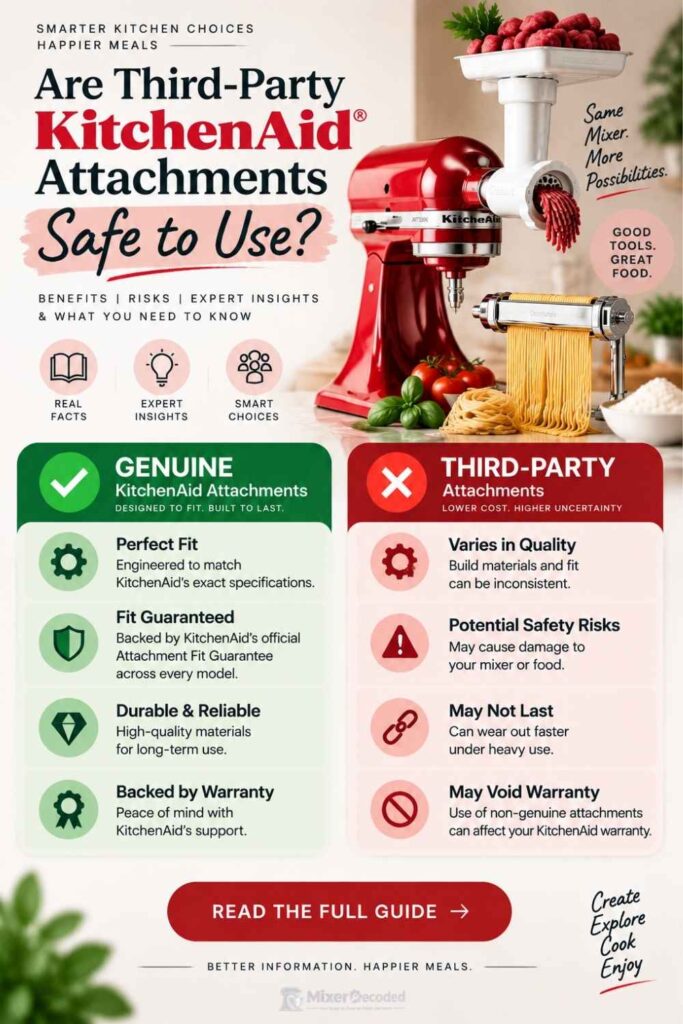
Are third-party KitchenAid attachments safe? Generally yes, physically usable, since most are designed to fit the same standard hub, but using them carries two real, distinct risks worth understanding before you buy: potential warranty complications and inconsistent build quality. Neither risk means you should never buy third-party, but both deserve a clear-eyed answer rather than a blanket yes or no.
Attachment Safety Check
Trusted
- Known manufacturer
- Food-safe materials
- Clear warranty
Be Careful
- Unknown seller
- Missing material details
- Limited product information
Avoid
- Cheap unbranded copies
- No safety information
- Poor customer reviews
Quick Answer: Small hardware, like a replacement thumbscrew, is low-risk to buy third-party. Full motorized or food-contact attachments, like grinders or pasta rollers, carry real warranty exposure and inconsistent build quality, and KitchenAid’s own policy specifically ties warranty coverage to damage caused by non-genuine parts. If you buy third-party, check reviews for fit and durability complaints first, and weigh the savings against how often you’ll actually use the attachment.
In this article, we’ll cover:
Are Third-Party KitchenAid Attachments Safe? What the Warranty Policy Actually Says
KitchenAid’s official guidance is direct about this. Their product help documentation specifically addresses non-genuine parts, warning that a non-genuine silicone scraping beater could damage the mixer, with warranty coverage not extending to damage caused specifically by that non-genuine part. Their official stand mixer attachment buying guide reinforces this same position, advising that only authentic attachments should be used to protect both the machine and its warranty coverage.
The important nuance here: this isn’t a blanket statement that using any third-party attachment voids your entire mixer’s warranty forever. It’s narrower than that:
- What’s typically still covered: the rest of your mixer’s warranty, including the motor, if the non-genuine part hasn’t caused any damage
- What’s typically at risk: coverage for any specific damage the non-genuine part causes to your mixer’s motor, hub, or gearing
If a third-party attachment causes damage to your mixer’s motor or hub, that specific damage may not be covered, even if the rest of your mixer’s warranty otherwise remains intact.
The Genuine Attachment Fit Guarantee, and What You Give Up Without It
One thing you lose entirely by going third-party is KitchenAid’s own Attachment Fit Guarantee. Every genuine KitchenAid attachment is printed with a stated promise that it fits every KitchenAid stand mixer, and if it genuinely doesn’t, KitchenAid will work with you directly to resolve it, regardless of the age of your mixer or the attachment.
Named exceptions to the guarantee:
- The ice cream maker attachment doesn’t fit the Artisan Mini, since the bowl is physically too large for the Mini’s smaller base
- The precise heat mixing bowl doesn’t fit the Artisan Mini for the same reason
Third-party attachments carry no equivalent guarantee. If a generic attachment doesn’t fit your specific mixer correctly, your recourse is typically limited to whatever return policy the seller or marketplace offers, not a manufacturer-backed compatibility promise.
Genuine KitchenAid
Attachment Fit Guarantee
- Printed fit promise included
- KitchenAid works with you if it does not fit
- Support applies regardless of mixer age
Named Exceptions
Some models have limits
- Ice cream maker does not fit Artisan Mini
- Precise Heat Mixing Bowl does not fit Artisan Mini
Third-Party
No equivalent guarantee
- Compatibility promise depends on seller
- Returns usually follow marketplace policy
- No manufacturer-backed fit support
The Lead Safety Question, and Why It’s More Complicated Than “Genuine Is Always Safer”
Here’s something worth knowing that complicates a simple “just buy genuine” answer: independent testing has raised real questions about lead content in KitchenAid’s own metal attachments, not just third-party ones. Testing conducted using XRF methodology, the same scientific approach used by the U.S. Consumer Product Safety Commission, found lead present across numerous genuine KitchenAid attachments, including both the coated and bare “burnished” metal finishes, at levels that would be considered unsafe under regulations that apply specifically to products intended for children’s use. This research has been covered by Consumer Reports.
Testing Raised Questions
Independent testing raised concerns about lead content in some metal attachments.
Context Matters
Product category, intended use, and applicable regulations affect how safety standards are evaluated.
KitchenAid’s Response
KitchenAid states that its aluminum accessories and coatings are independently tested for compliance with applicable regulations.
It’s important to be precise about what this does and doesn’t mean. Kitchenware intended for adult use is regulatory-exempt from the specific lead standards that apply to children’s products, so this isn’t a claim that KitchenAid’s attachments violate any law that actually applies to them. KitchenAid has responded publicly to this concern, stating that both the base aluminum alloy and its coating have been tested by an independent third-party laboratory and are represented as compliant with applicable lead content regulations.
The practical takeaway for the third-party question specifically: since even genuine KitchenAid metal attachments have raised documented lead-testing concerns, “is it genuine” isn’t actually the full safety question for metal attachments in either direction. Material composition matters more than brand origin here, and neither genuine nor third-party status guarantees a particular outcome on this specific issue.
Real Quality Differences Beyond Warranty and Materials
Setting aside warranty and lead content, there’s a genuine, documented quality gap in day-to-day performance between many third-party attachments and genuine ones. Real user reviews of aftermarket meat grinder attachments, for example, report a consistent tradeoff: meaningfully lower cost, but recurring complaints about excessive clogging and heat transfer during use compared to genuine attachments. This isn’t true of every third-party manufacturer or every attachment type, quality varies significantly between aftermarket brands, but it’s a documented pattern worth weighing against the cost savings.
Lower Cost
Many aftermarket attachments offer meaningful savings compared with genuine options.
Performance Trade-Offs
User reports on some attachments mention issues like excessive clogging and heat transfer during use.
Quality Varies
Not every third-party manufacturer is the same. Performance depends on the brand and attachment.
Not All Third-Party Parts Carry the Same Risk
One distinction worth making before you write off aftermarket parts entirely: small hardware components carry meaningfully less risk than full motorized or mechanical attachments.
Small Hardware & Fasteners
Lower Risk- No moving parts
- No direct food contact
- Less impact on mixer motor or gearing
- Depends on correct manufacturing dimensions
Motorized & Mechanical Attachments
Higher Risk- Engages the mixer drive mechanism
- Food-contact material considerations
- Adds fit and performance concerns
- Greater consequences if poorly made
How to Evaluate a Third-Party Attachment Before Buying
Identify what type of attachment it is. Small hardware and fasteners carry low risk. Motorized, mechanical, or food-contact attachments carry meaningfully more.
Check real user reviews specifically for fit and durability complaints, not just star ratings, since the documented pattern is inconsistent build quality rather than universal failure.
Confirm your model number against the seller’s stated compatibility list. See How to Find and Decode Your KitchenAid Model Number if you haven’t already located yours.
Weigh the warranty exposure against the specific attachment’s cost and how essential a perfect long-term fit is to you. A rarely used attachment carries different risk tolerance than one you’d run heavily and often.
For anything food-contact or metal, factor in material composition questions generally, since this is a genuine open question that applies somewhat regardless of brand origin, based on the research above.
Pro Tips
- Read the manufacturer’s material spec, not just the product title. Listings that specify food-grade stainless steel or state the exact alloy are giving you real, checkable information. Listings that just say “durable metal” or “premium material” with no specifics are a weaker signal, regardless of price.
- Search the exact attachment name plus “clogging” or “durability” before buying. Real owner complaints about specific failure modes surface faster this way than scrolling through star ratings, which tend to average out documented problems.
- Keep your genuine KitchenAid receipt and any third-party attachment receipts separate and dated. If a warranty question ever comes up, having a clear record of exactly when you introduced a non-genuine part makes resolving it far easier than trying to reconstruct a timeline from memory.
- Buy genuine for anything you’ll run heavily or rarely replace. The math on warranty risk changes a lot between an attachment you’ll use for one holiday project a year versus one that becomes part of your regular routine.
- Treat hardware and full attachments as separate purchasing decisions entirely. It’s reasonable to buy a third-party thumbscrew without hesitation while still choosing genuine for a grinder or pasta roller. Bundling these into one blanket “third-party, yes or no” decision misses the real risk difference between them.
Frequently Asked Questions
Will using a third-party attachment void my entire KitchenAid mixer warranty?
Not automatically. KitchenAid’s stated policy ties warranty exposure specifically to damage caused by the non-genuine part itself, rather than voiding your mixer’s entire warranty simply for having used one. That said, this narrower exposure is still a real risk if the attachment does cause damage.
Are third-party KitchenAid attachments safe to use overall?
Physically usable in most cases, since they’re generally designed to fit the same standard hub. Safety and quality vary significantly by manufacturer and attachment type, with small hardware carrying low risk and full motorized or food-contact attachments carrying more risk and more variability.
Do third-party attachments fit as well as genuine KitchenAid ones?
Often, but not with the same guarantee. Genuine attachments come with KitchenAid’s official Attachment Fit Guarantee; third-party attachments do not, so fit issues are typically resolved through the seller’s return policy rather than manufacturer support.
Is it actually safer to just buy genuine KitchenAid attachments?
For warranty protection and fit guarantee purposes, yes. For the specific lead-content question, the research shows this isn’t guaranteed to differ meaningfully by brand origin for metal attachments, since documented testing has raised concerns about genuine KitchenAid metal attachments as well.
Final Thoughts
The honest answer to whether third-party KitchenAid attachments are safe is that it depends on what you’re buying and what you’re optimizing for. Small hardware parts are low-risk.
Full motorized and food-contact attachments carry real warranty exposure and documented quality variability. And the lead-content question, somewhat surprisingly, doesn’t resolve cleanly in favor of genuine attachments either, based on independent testing of KitchenAid’s own metal parts.
The most useful approach is treating each attachment purchase individually rather than applying a single blanket rule to every third-party product.
Related Reading:
KitchenAid Attachment Compatibility Guide
How to Find and Decode Your KitchenAid Model Number
Last Updated on September 7, 2026 by Susan Joy