
If you’re researching KitchenAid food grinder attachment compatibility, the good news is that the basic answer is simpler than many product listings make it seem: KitchenAid’s hub-powered food grinder attachments are designed to connect to the power hub on KitchenAid household stand mixers.
Where things get confusing is when you start comparing KSMFGA, KSMMGA, FGA, 5KSMFGA, older grinder parts, replacement blades, grinding plates, or secondhand attachments. Before checking whether a grinder will fit, the first step is to identify your KitchenAid mixer model.
I’ve looked at KitchenAid’s current product information, older product documentation, and compatibility guidance, and there is one distinction I think every buyer should understand:
Compatibility with the mixer is not the same thing as compatibility between different generations of grinder parts.
That distinction can save you from buying an attachment that fits your mixer but discovering that the replacement plates or accessories you already own don’t fit the grinder itself.
Quick Answer: Does the KitchenAid Food Grinder Fit My Mixer?
Yes — current KitchenAid food grinder attachments are designed to work with KitchenAid stand mixers through the front power hub.
KitchenAid lists models such as the KSMFGA and KSMMGA as compatible with all KitchenAid stand mixers. The older FGA was also documented as compatible with KitchenAid household stand mixers.
The important compatibility detail
The bigger compatibility issue is usually not the connection between the grinder and your mixer. It is whether replacement grinder parts such as blades, grinding plates, collars, and other components belong to the same grinder generation.
In other words, a grinder can fit your KitchenAid mixer while a replacement part may still be incompatible with that grinder.
In this article, we’ll cover:
KitchenAid Food Grinder Compatibility at a Glance
The current KitchenAid food grinder attachments are designed to connect to KitchenAid household stand mixers through the front power hub. The important distinction is that grinder-to-mixer compatibility is different from replacement-part compatibility. KitchenAid attachment compatibility depends on more than simply matching the attachment to the mixer.
| Grinder Model | Mixer Compatibility | What to Watch |
|---|---|---|
| KSMFGA Food Grinder | All household KitchenAid stand mixers | Match replacement blades, plates, and other components to the correct grinder model and generation. |
| KSMMGA Metal Food Grinder | All household KitchenAid stand mixers | Do not assume parts from older grinder generations will fit the metal grinder. |
| FGA Older Food Grinder | KitchenAid household stand mixers | Older grinder generation. Verify replacement-part compatibility before purchasing newer components. |
| 5KSMFGA Regional Model | KitchenAid stand mixers | Check the model-specific regional documentation when purchasing replacement parts or accessories. |
A food grinder can be compatible with your KitchenAid mixer while a particular replacement blade, grinding plate, collar, or accessory is incompatible with that grinder. Always match replacement parts to the exact grinder model.
Checking the mixer? Start with the power hub. Checking a replacement part? Start with the grinder model number.
KitchenAid Food Grinder Attachment Compatibility: The Basic Rule
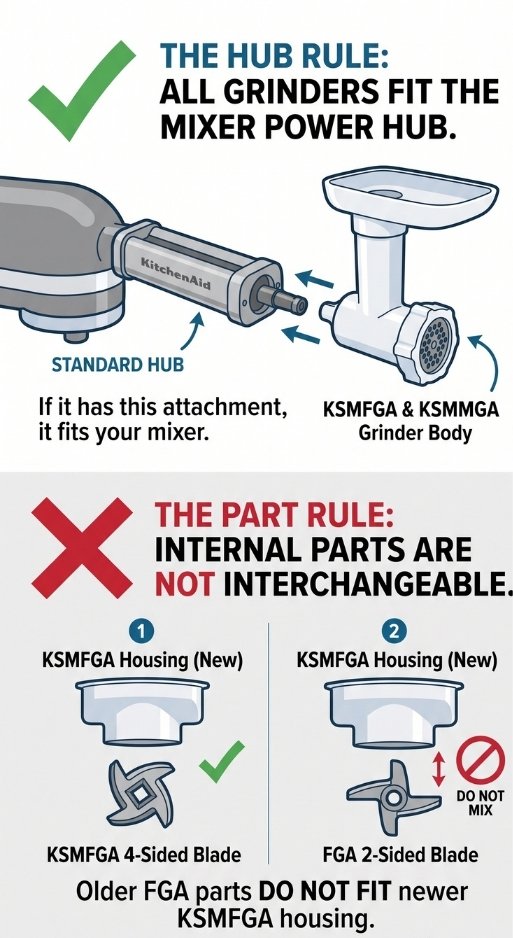
KitchenAid food grinder attachment compatibility is mainly determined by how the attachment connects to the mixer’s front power hub. If the grinder is designed for KitchenAid’s household stand mixer attachment hub, the mixer itself is generally not the limiting factor.
The mixer provides the power used by the attachment.
The attachment mounts to the standardized front attachment hub.
The grinder housing transfers the mixer’s rotational power to its internal grinding mechanism.
These components determine how the food is processed inside the grinder.
Mixer Compatibility vs. Grinder-Part Compatibility
These are two different compatibility questions. A KitchenAid food grinder can be compatible with a stand mixer while a replacement blade, grinding plate, collar, or other component may not be compatible with that particular grinder.
This distinction becomes especially important when comparing the current KSMFGA and KSMMGA with older FGA grinder systems. The mixer connection can be broadly compatible even when individual grinder components belong to different generations.
Why the KitchenAid Power Hub Matters
KitchenAid stand mixer attachments such as food grinders are designed to use the attachment hub at the front of the mixer. That is why you do not normally need to match a grinder to the mixer by bowl size, beater style, or whether the mixer is a tilt-head or bowl-lift model.
When checking a grinder for your mixer, the first question is whether the mixer has the appropriate front attachment power hub. Once that connection is established, the next compatibility question is the grinder itself and its replacement components.
Mixer → Power Hub → Grinder
Then check the exact grinder model before buying replacement parts.Buying the complete grinder? Check the mixer-to-hub compatibility. Buying a replacement part? Check the grinder model and generation first.
Which KitchenAid Mixers Are Compatible With the Food Grinder?
KitchenAid states that its food grinder attachments connect to the power hub of household KitchenAid stand mixers. That means compatibility is not limited to one specific mixer family or body style. The important connection point is the front attachment hub.
The older FGA was also approved for use with all KitchenAid household stand mixers according to its KitchenAid instruction manual.
Tilt-Head KitchenAid Mixers
A tilt-head mixer can use a compatible KitchenAid food grinder through its front attachment hub. The tilt-head design itself does not prevent the grinder from connecting.
Compatible through the front power hubBowl-Lift KitchenAid Mixers
Bowl-lift mixers also use the front attachment hub for compatible stand mixer attachments. The bowl-lift mechanism does not change the basic grinder connection.
Compatible through the front power hubOlder KitchenAid Stand Mixers
An older KitchenAid stand mixer is not automatically excluded. KitchenAid’s older FGA documentation states that the grinder was approved for all household KitchenAid stand mixers.
Do not reject an older mixer by age aloneDoes the KitchenAid Food Grinder Fit the Artisan Mini?
Do not assume compatibility from the word “KitchenAid” alone. For a Mini or another less-common model, identify the exact mixer model and confirm the attachment documentation before purchasing.
Verify the exact model before buyingIf you are buying a complete grinder, start by identifying the mixer model and confirming the attachment documentation. If you are buying replacement parts, identify the grinder model separately.
Tilt-head, bowl-lift, or older? The mixer body style alone does not determine food grinder compatibility. The key connection is the KitchenAid front attachment power hub, while replacement parts require a separate grinder-model check.
KSMFGA vs. KSMMGA: What’s the Difference?
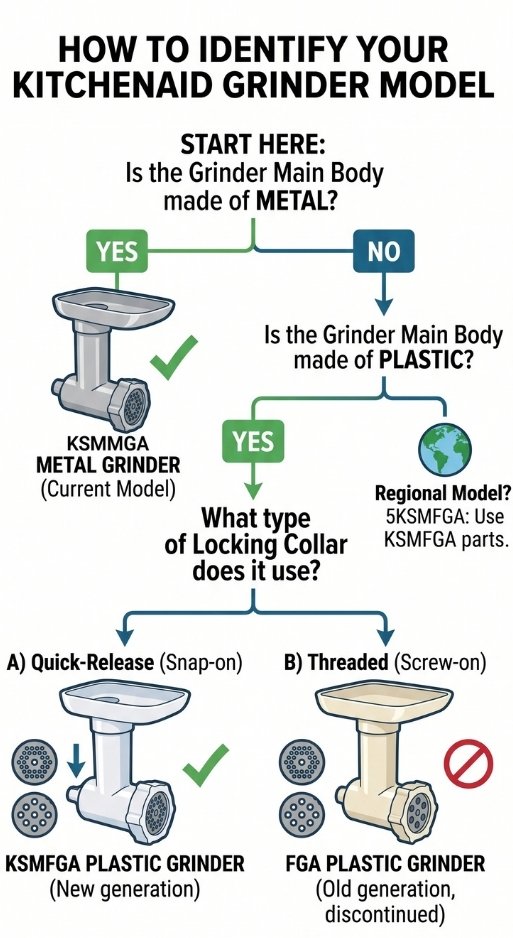
The KSMFGA and KSMMGA are both KitchenAid food grinder attachments designed to connect to the front power hub of a household KitchenAid stand mixer. The important difference is the grinder construction and component design—not a different mixer connection.
KSMFGA and KSMMGA use different grinder designs, with KSMMGA identified by KitchenAid as the metal food grinder attachment.
The exact plates, blade, tray, pusher, storage, and other accessories can vary by grinder model and package.
A part that looks similar does not automatically belong to both systems. Always identify the grinder model before ordering replacement components.
KSMFGA and KSMMGA can use the same KitchenAid mixer hub, but that does not mean their individual grinder components are interchangeable.
If you are choosing a complete grinder, compare the grinder design and included accessories. If you are buying a replacement part, use the exact grinder model number rather than assuming KSMFGA and KSMMGA parts are interchangeable.
Which KitchenAid Food Grinder Should You Choose?
Comparing the KitchenAid KSMFGA and KSMMGA? Review their specifications, included accessories, pros and cons, and compatibility before buying.
KitchenAid KSMFGA Food Grinder Attachment
A practical option for everyday grinding and basic food preparation.

Product Specifications
- Model
- KSMFGA
- Type
- Stand mixer food grinder attachment
- Grinding plates
- Fine 4.5 mm and coarse 6 mm
- Included accessories
- Food tray, food pusher, fine plate and coarse plate
- Power source
- Powered by the stand mixer’s attachment hub
- Compatibility
- KitchenAid household stand mixers with the compatible attachment hub
Pros
- Provides fine and coarse grinding options for different food textures.
- Useful for grinding meat, vegetables, and other suitable ingredients.
- Compact accessory setup for regular home food preparation.
- Designed to connect to the KitchenAid stand mixer attachment hub.
Cons
- Does not include a medium grinding plate in the standard package.
- Does not include the full sausage-stuffing accessory set supplied with the KSMMGA.
- Replacement parts from older FGA and KSMMGA systems should not be assumed compatible.
- Requires a compatible KitchenAid stand mixer; it is not a standalone electric grinder.
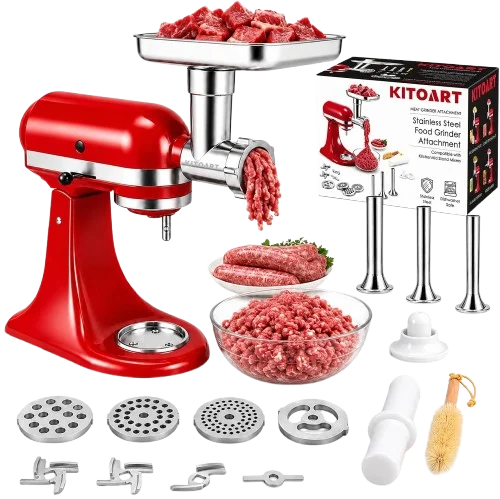
KitchenAid KSMMGA Metal Food Grinder Attachment
A metal grinder package with additional grinding and sausage-making accessories.
Product Specifications
- Model
- KSMMGA
- Type
- Metal stand mixer food grinder attachment
- Grinding plates
- Fine, medium and coarse
- Included accessories
- Removable food tray, food pusher, three grinding plates, cleaning brush, small and large sausage stuffer tubes, and stuffer plate
- Power source
- Powered by the stand mixer’s attachment hub
- Compatibility
- KitchenAid household stand mixers with the compatible attachment hub
Pros
- Metal grinder construction for users who prefer a metal grinding assembly.
- Includes fine, medium, and coarse grinding plates for more texture options.
- Includes sausage-stuffing accessories in the standard package.
- Comes with a cleaning brush to help clean the grinding components.
Cons
- May include accessories that occasional users do not need.
- Requires a compatible KitchenAid stand mixer and is not a standalone grinder.
- KSMMGA replacement parts are not automatically compatible with KSMFGA or older FGA parts.
- Buyers replacing one component must confirm the exact KSMMGA part rather than relying on appearance alone.

Does the Old FGA Fit a KitchenAid Stand Mixer?
Yes. The fact that the KitchenAid FGA is an older food grinder does not mean it was designed for only a limited group of KitchenAid mixers. KitchenAid’s FGA documentation states that the attachment was approved for use with all KitchenAid household stand mixers.
The FGA can connect to a compatible KitchenAid stand mixer through the front attachment hub. That does not mean every newer grinder blade, plate, collar, or accessory will automatically fit the older FGA.
FGA Mixer Compatibility
The original FGA was designed to connect to the front attachment hub of KitchenAid household stand mixers. Its age alone should not be treated as evidence that it will not fit a KitchenAid mixer.
FGA Replacement-Part Compatibility
Replacement parts are a different matter. An older FGA belongs to its own grinder generation, so a newer KitchenAid grinder component should not be assumed to fit simply because both parts are called blades, plates, or collars.
If you find an FGA in a secondhand listing, the useful question is not simply whether it is old. Identify the grinder and its components, then verify the specific replacement part you need.
FGA + KitchenAid stand mixer: the older FGA was approved for KitchenAid household stand mixers. FGA + newer replacement part: verify the exact part compatibility before buying. If you’re dealing with an older KitchenAid, see our guide to modern attachments on older KitchenAid mixers before assuming that the grinder’s age makes it incompatible.
KSMFGA and Older FGA Parts: Don’t Assume Interchangeability
A KitchenAid food grinder can fit the mixer while its replacement parts still belong to a different grinder system. The KSMFGA and older FGA should therefore be treated as separate grinder generations when checking blades, grinding plates, collars, screws, and other components.
A blade, plate, collar, or accessory may look similar to another KitchenAid part but still belong to a different grinder system. Check the exact grinder model and manufacturer compatibility information before buying a replacement.
FGA Food Grinder
The discontinued FGA is an older KitchenAid food grinder system. Its replacement components and accessories should be identified specifically for the FGA rather than assumed to match newer grinder generations.
KSMFGA Food Grinder
The KSMFGA is a newer KitchenAid food grinder system with its own components and accessory ecosystem. KitchenAid identifies specific accessories as requiring the KSMFGA.
Do not assume they can. KitchenAid documentation distinguishes the newer KSMFGA system from the discontinued FGA system, and some newer accessories are explicitly listed as incompatible with FGA. For a replacement blade, plate, collar, or other component, verify the exact part against the grinder model before ordering.
Why Grinder Generations Matter
Start with FGA, KSMFGA, KSMMGA, or the exact model shown on the attachment or documentation.
Know whether you need a blade, grinding plate, grind screw, collar, tray, or another component.
Use the manufacturer’s part information instead of relying only on dimensions, appearance, or seller descriptions.
If the grinder model or part number is unknown, ask for clear identification before assuming the component will fit.
What Does the KitchenAid Food Grinder Do?
The KitchenAid food grinder attachment uses your stand mixer’s front power hub to process ingredients into smaller pieces. Depending on the grinder model and grinding plate, you can use it for foods such as meat, vegetables, hard cheese, and bread crumbs.
Place the prepared food into the grinder tray and guide it into the feed tube.
The rotating grind screw moves the food toward the blade and grinding plate.
The openings in the grinding plate determine how finely the ingredient is processed.
Fine Grinding Plate
The fine plate produces a smaller grind and is intended for applications such as cooked meats for spreads, hard cheeses, and bread crumbs.
Coarse Grinding Plate
The coarse plate produces a larger grind and is intended for applications such as raw meat for burgers and chili, along with vegetables for salsas and sauces.
Medium Grinding Plate
The KSMMGA Metal Food Grinder also includes a medium grinding plate, giving that grinder system an additional grind-size option between its fine and coarse plates.
Not every KitchenAid food grinder includes the same grinding plates. The KSMFGA includes fine and coarse plates, while the KSMMGA includes fine, medium, and coarse plates. Always check the exact grinder model before buying additional plates or replacement components.
What Can You Use a KitchenAid Food Grinder For?
Process prepared meat for dishes such as burgers and chili.
Use the appropriate fine-grinding setup for hard cheeses such as Parmesan.
Grind suitable bread into crumbs for cooking and baking applications.
The coarse plate can be used for vegetables in applications such as salsas and sauces.
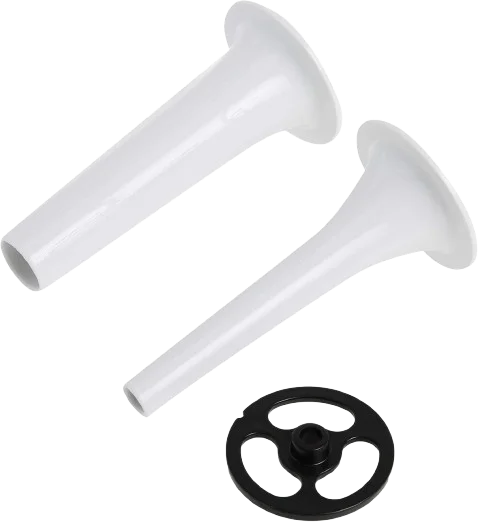
KitchenAid KSMSSA Sausage Stuffer Kit
Make homemade breakfast sausages, bratwurst, and other sausages using your compatible KitchenAid food grinder and stand mixer.
Product Specifications
- Model number
- KSMSSA
- Product type
- Sausage stuffer accessory kit
- Small stuffing tube
- 3/8 inch (9.5 mm)
- Large stuffing tube
- 5/8 inch (15.9 mm)
- Included accessories
- Small and large sausage stuffer tubes
- Required equipment
- KSMFGA food grinder and compatible KitchenAid stand mixer, sold separately
- Cleaning
- KitchenAid describes the kit’s parts as dishwasher safe
Which Stuffing Tube Do You Need?
Designed for breakfast sausage and other smaller sausages.
Designed for larger varieties, including bratwurst, Italian sausage, and Polish sausage.
Pros
- Includes two tube sizes for different sausage varieties.
- Works with the KSMFGA food grinder to support homemade sausage preparation.
- Allows users to prepare smaller breakfast sausages and larger sausage varieties.
- Dishwasher-safe parts make cleanup more convenient, subject to the care instructions.
- Uses the power of an existing compatible KitchenAid stand mixer and food grinder.
Cons
- Does not include the food grinder or stand mixer.
- Not compatible with the discontinued FGA food grinder.
- Its parts are not interchangeable with the KSMMGA metal grinder system.
- Only two stuffing tube sizes are included; the kit is not a complete standalone sausage-making machine.
- Requires the compatible grinder assembly to be set up before stuffing sausages.
KitchenAid owners who already have the KSMFGA food grinder and want to add sausage-stuffing functionality without purchasing another complete grinder package.
KitchenAid identifies KSMSSA as an accessory for the KSMFGA food grinder. It is not compatible with the discontinued FGA grinder. KitchenAid also states that KSMSSA parts and accessories are not interchangeable with KSMMGA or FGA parts.
If you own the KSMMGA metal grinder, use the sausage-stuffing components specified for that system. Do not assume that the KSMSSA tubes or stuffer plate will fit simply because they look similar.
What Comes With a KitchenAid Food Grinder?
The exact contents of a KitchenAid food grinder package depend on the model. The KSMFGA includes the basic grinder setup with fine and coarse grinding plates, while the KSMMGA includes additional grinding and sausage-stuffing components.
KSMFGA Food Grinder Attachment
The KSMFGA comes with the core components needed for grinding, including two grinding plates.
KSMMGA Metal Food Grinder Attachment
The KSMMGA includes three grinding plates plus sausage-stuffing components and a cleaning brush.
A simpler package focused on the core food-grinding function, with fine and coarse plates.
A more extensive package with a third grinding plate and included sausage-stuffing components.
Two KitchenAid grinder models can connect to the same mixer power hub while still using different grinder components and accessories. If you are replacing a missing or damaged part, identify the exact grinder model first.
How to Install a KitchenAid Food Grinder Attachment
Installing a KitchenAid food grinder is straightforward once the attachment and its internal components are assembled correctly. The grinder connects to the stand mixer through the front power hub, so the attachment must be fully seated and secured before use.
Turn the mixer off and unplug it before installing, removing, or adjusting the grinder attachment. Keep hands and utensils away from the feed tube while the grinder is operating.
Turn Off and Unplug the Mixer
Set the mixer controls to the off position and disconnect the power before attaching the grinder. This gives you a safe starting point while working around the mixer hub and grinder components.
Remove the Hub Cover
Loosen the attachment-hub cover or attachment knob on the front of the mixer according to your KitchenAid stand mixer model.
Insert the Grinder Shaft
Align the grinder attachment shaft with the front power hub. Insert the attachment while gently rotating it as needed until it is properly positioned inside the hub.
Secure the Attachment
Position the attachment correctly in the hub and tighten the attachment knob so the grinder is held firmly in place.
Install the Correct Grinder Components
Install the grind screw, blade, and selected grinding plate according to the instructions for your specific grinder model. Secure the retaining ring or collar as required.
Confirm the grinder is properly secured to the mixer hub.
Use components intended for your exact grinder model.
Prepare ingredients according to the manufacturer’s instructions.
Why Is My KitchenAid Food Grinder Not Working?
If your KitchenAid food grinder is not working properly, the problem is not always the mixer itself. A grinder that will not turn, grinds poorly, or produces mushy food can be affected by attachment alignment, ingredient preparation, the blade or grinding plate, or incompatible grinder components.
Start with the attachment before assuming the mixer has a fault. Check that the grinder is fully seated in the front power hub, then inspect the blade, grinding plate, and food preparation. If replacement parts came from another grinder generation, verify their compatibility with the exact grinder model.
The Grinder Is Not Fully Seated
If the attachment is not correctly positioned inside the mixer hub, the grinder may not operate as expected. Remove the attachment, check the hub alignment, and reinstall it according to the instructions for your grinder model.
The Hub Screw Is Not Securing the Attachment
A loose attachment can move during operation instead of remaining firmly positioned in the power hub. Make sure the attachment is seated correctly before tightening the hub screw or attachment knob.
The Food Is Too Soft, Tough, or Fibrous
Ingredient preparation can affect grinding performance. Meat that is too soft or warm can produce a poor grind, while tough connective tissue or fibrous ingredients can interfere with smooth feeding through the grinder.
The Blade or Plate Needs Attention
A blade or grinding plate that is worn, damaged, incorrectly assembled, or obstructed can affect grinding performance. Stop the mixer, unplug it, and inspect the grinder components before continuing.
The Grinder Parts Are From Different Generations
This is an especially important compatibility check. A KitchenAid mixer may accept the grinder through its front power hub while a replacement blade, plate, or accessory still belongs to a different grinder system. Do not assume an FGA component will work with a KSMFGA or KSMMGA simply because the part looks similar.
Match the Symptom to the First Check
If the mixer or grinder shows signs of electrical damage, unusual burning smells, damaged components, or another potentially unsafe condition, discontinue use and follow the manufacturer’s service or support guidance rather than continuing to operate the attachment.
Can You Sharpen a KitchenAid Food Grinder Blade?
A KitchenAid food grinder blade is a precision cutting component, so poor grinding performance does not automatically mean the blade should be sharpened at home. Before replacing or servicing the blade, check the blade condition, grinding plate, assembly, and exact grinder model.
It is generally safer to replace a worn or damaged KitchenAid grinder blade with the correct model-specific replacement than to sharpen it yourself.
The blade works together with the grinding plate, so changing its cutting geometry can affect how the grinder performs.Why this matters: The blade and grinding plate work as a pair. A problem with either component can produce poor grinding results.
Before Replacing or Servicing the Blade
Look for visible damage, excessive wear, corrosion, or other signs that the component may no longer be suitable for use.
A damaged, worn, obstructed, or incorrectly fitted plate can also affect the quality of the grind.
Confirm that the grind screw, blade, grinding plate, and retaining ring are assembled correctly for the grinder model.
Replacement blades should be matched to the exact grinder system rather than selected solely because they look similar.
Sharpen or Replace?
Stop the mixer, unplug it, disassemble the grinder safely, and clean the appropriate components according to the manufacturer’s instructions.
Do not continue using a damaged component. Identify the correct replacement for the specific grinder model.
Similar appearance does not establish compatibility. Check the grinder model and manufacturer’s part information before ordering.
FGA, KSMFGA, and KSMMGA belong to different grinder systems. If you need a replacement blade, identify the exact grinder model first and then verify that the replacement is intended for it.
Does the KitchenAid Food Grinder Work With a KitchenAid Mini?
Most KitchenAid food grinder compatibility problems come from checking the wrong part of the system. A mixer may accept the grinder through its power hub, while individual grinder components can still belong to a different generation.
Mixer compatibility and replacement-part compatibility are two different checks. Never use one as a substitute for the other.
Assuming Every KitchenAid Grinder Part Is Interchangeable
KitchenAid has multiple food grinder systems, including FGA, KSMFGA and KSMMGA. Their components should not automatically be treated as universal parts.
Confusing Mixer Compatibility With Part Compatibility
A food grinder can be designed to connect to the KitchenAid stand mixer power hub without every grinder component being compatible across different grinder generations.
Buying Replacement Parts by Appearance Alone
Two blades, plates or trays can look very similar while belonging to different grinder systems. Physical appearance alone does not establish compatibility.
Assuming FGA Means Incompatible With Modern Mixers
The FGA is an older KitchenAid food grinder, but “older” does not automatically mean “incompatible with a stand mixer.” KitchenAid’s FGA documentation states that the attachment was approved for use with all KitchenAid household stand mixers.
Ignoring the Product Model Number
Product names such as “KitchenAid food grinder” are not precise enough when you are replacing individual components. The model number gives you a much better starting point.
Assuming Every Package Contains the Same Accessories
KSMFGA and KSMMGA do not have identical included accessory sets. For example, KSMFGA includes fine and coarse grinding plates, while KSMMGA includes fine, medium and coarse plates plus sausage stuffing components.
Assuming a Secondhand Attachment Includes Compatible Parts
A used grinder may have been sold with missing, substituted or mixed components. The attachment body itself does not prove that every part included in the listing belongs to the same grinder system.
“It looks like the same part.”
Similar appearance does not prove that a grinder component belongs to the same KitchenAid system.
Model → Part → Compatibility
Identify the grinder model, identify the exact component, then verify that the manufacturer lists the part for that system.
Before You Buy a KitchenAid Grinder or Replacement Part
-
1Identify the mixer Check the stand mixer model.
-
2Identify the grinder Check whether it is FGA, KSMFGA, KSMMGA or another model.
-
3Identify what you are buying Complete grinder, blade, plate, tray, stuffer or another part.
-
4Verify the exact compatibility Use manufacturer documentation rather than appearance alone.
Can You Use a KitchenAid Food Grinder on a Very Old Mixer?
If I were checking a KitchenAid food grinder or replacement part before spending money, I would verify the compatibility in a specific order. This prevents a common mistake: confirming that the grinder fits the mixer without checking whether the individual parts belong to that grinder system.
Check 1: Identify the Mixer
Start with the KitchenAid stand mixer itself. Find the model number rather than relying only on a name such as Artisan, Classic or Professional.
- Exact mixer model number
- Mixer type, if known
- Whether it has the front power hub
Check 2: Identify the Grinder
Next, identify the exact grinder model. This is especially important when buying a used attachment or replacement parts for an older KitchenAid grinder.
Check 3: Determine Whether You Need the Complete Grinder or Parts
This changes the compatibility question. If you are buying the complete grinder, check whether it connects to your mixer. If you are replacing a component, check whether that specific component belongs to your grinder system.
Check 4: Compare the Manufacturer’s Documentation
Once you know the mixer and grinder model, compare the manufacturer’s product page, owner’s manual or compatibility information. This is more reliable than matching a part by shape, size or a seller’s description alone.
Check 5: Check Secondhand Listings Carefully
A used KitchenAid grinder deserves an extra compatibility check. Do not assume that every component shown in a listing originally belonged to the attachment. Missing or substituted parts can turn a seemingly complete grinder into an incomplete or mixed system.
What Are You Actually Trying to Buy?
Mixer model → Grinder model → Exact part → Manufacturer verification
If you cannot verify one of these four steps, do not rely on appearance or a generic “fits KitchenAid” description alone.KitchenAid Food Grinder Compatibility Mistakes to Avoid
Most KitchenAid food grinder compatibility problems happen because buyers check the wrong part of the system. A grinder may connect to a KitchenAid stand mixer, while individual grinder components can still belong to a different grinder generation.
Mixer compatibility and replacement-part compatibility are separate checks. Never use one as proof of the other.
Assuming Every KitchenAid Grinder Part Is Interchangeable
KitchenAid has different food grinder systems, including FGA, KSMFGA and KSMMGA. Their components should not automatically be treated as universal KitchenAid grinder parts.
Confusing Mixer Compatibility With Part Compatibility
KitchenAid’s grinder attachments connect through the stand mixer’s power hub, but that does not mean individual grinder components are interchangeable between different grinder systems.
Buying Replacement Parts by Appearance Alone
Two blades, plates or trays can look similar while belonging to different KitchenAid grinder systems. Shape or appearance alone does not establish compatibility.
Assuming FGA Means Incompatible With Modern Mixers
The FGA is an older KitchenAid food grinder, but its age does not automatically make it incompatible with a KitchenAid stand mixer. The more important question is whether you are checking the complete grinder or a replacement component.
Ignoring the Product Model Number
A description such as “KitchenAid food grinder” is not precise enough when you are trying to replace an individual component. The grinder model number gives you a much better starting point.
Assuming Every Package Contains the Same Accessories
KSMFGA and KSMMGA do not have identical included accessory sets. KSMFGA includes fine and coarse grinding plates, while KSMMGA includes fine, medium and coarse plates plus sausage-stuffing components.
Assuming a Secondhand Attachment Includes Compatible Parts
A used grinder may be missing components or may have been listed with replacement parts that were added later. A complete-looking attachment does not automatically prove that every component belongs to the same grinder system.
“It looks like the same part.”
Similar appearance does not prove that a grinder component belongs to the same KitchenAid system.
Model → Part → Compatibility
Identify the grinder model, identify the exact component, then verify that KitchenAid lists the part for that system.
Before You Buy a KitchenAid Grinder or Replacement Part
-
1Identify the mixer Check the stand mixer model.
-
2Identify the grinder Check whether it is FGA, KSMFGA, KSMMGA or another model.
-
3Identify what you need Complete grinder, blade, plate, tray, stuffer or another part.
-
4Verify compatibility Use manufacturer documentation rather than appearance alone.
How I Would Check KitchenAid Food Grinder Compatibility Before Buying
Before buying a KitchenAid food grinder or replacement part, check the system in the right order. Start with the mixer, identify the grinder, determine exactly what you need, and then verify the manufacturer’s compatibility information.
Check 1: Identify the Mixer
Start with the KitchenAid stand mixer. Find its exact model number rather than relying only on a name such as Artisan, Classic or Professional.
- Exact mixer model number
- Mixer type, if known
- Whether the mixer has the front power hub
Check 2: Identify the Grinder
Next, identify the exact grinder model. This becomes especially important when you are buying a used attachment or replacement parts for an older KitchenAid grinder.
Check 3: Determine Whether You Need the Complete Grinder or Parts
This changes the compatibility question. If you are buying the complete grinder, check it against your mixer. If you are replacing a component, check that specific component against your grinder.
Check 4: Compare the Manufacturer’s Documentation
Once you know the mixer and grinder model, compare the manufacturer’s product page, owner’s manual or replacement-parts information. This is more reliable than matching a component by appearance alone.
Check 5: Check Secondhand Listings Carefully
A used KitchenAid grinder deserves an extra compatibility check. Do not assume every component shown in a listing originally came with that attachment. Missing, substituted or mixed parts can change what you actually receive.
What Are You Actually Trying to Buy?
Mixer model → Grinder model → Exact part → Manufacturer verification
If one of these steps cannot be verified, do not rely on appearance or a generic “fits KitchenAid” description alone.KitchenAid Food Grinder Compatibility Chart
Use this chart to separate mixer-to-grinder compatibility from grinder-part compatibility. The complete grinder may work with a KitchenAid stand mixer even when its individual replacement parts are not interchangeable with another grinder system.
| Grinder Model | Complete Grinder | Grinding Plates | Part Compatibility | Key Detail |
|---|---|---|---|---|
| KSMFGA Food Grinder Attachment | Compatible Designed to connect to the power hub of KitchenAid stand mixers. |
Fine + Coarse
4.5 mm fine 6 mm coarse | Model-specific KSMFGA parts should not be assumed compatible with FGA or KSMMGA. | Modern plastic food grinder system with fine and coarse plates. |
| KSMMGA Metal Food Grinder Attachment | Compatible Designed to connect to the power hub of KitchenAid stand mixers. |
Fine + Medium + Coarse
3 mm fine 4.5 mm medium 8 mm coarse | Model-specific KSMMGA parts should not be assumed compatible with FGA or KSMFGA. | Metal grinder system with three grinding plates and sausage-stuffer components. |
| FGA Older Food Grinder Attachment | Compatible Older KitchenAid documentation approved the FGA for household KitchenAid stand mixers. | Check exact system Do not infer compatibility from a newer grinder’s plate sizes. | Verify Do not assume newer KSMFGA or KSMMGA components fit the FGA. | Older grinder generation. Its age does not by itself mean the complete attachment is incompatible with a KitchenAid mixer. |
| 5KSMFGA Regional KSMFGA designation | Verify Confirm the exact regional model documentation before purchasing. | Fine + Coarse Confirm the exact model documentation. | Verify Match replacement parts to the exact model documentation. | Treat regional model numbers carefully rather than assuming every similarly named grinder part is interchangeable. |
Complete grinder: check the grinder against your KitchenAid
stand mixer.
Replacement part: check the part against the exact grinder
model and generation.
Which KitchenAid Grinder Are You Checking?
Frequently Asked Questions
Does the KitchenAid food grinder fit every KitchenAid stand mixer?
Current KitchenAid food grinder models such as the KSMFGA and KSMMGA are listed by KitchenAid as compatible with all KitchenAid stand mixers.The older FGA was also documented as approved for all KitchenAid household stand mixers.
Will a KitchenAid meat grinder fit a KitchenAid Artisan mixer?
Yes. The food grinder connects to the KitchenAid stand mixer’s front power hub, and KitchenAid lists current grinder attachments as compatible with all KitchenAid stand mixers.
Will the KitchenAid food grinder fit a bowl-lift mixer?
Yes. The food grinder uses the front attachment hub rather than the bowl mechanism, so compatible hub-powered grinders work with household bowl-lift KitchenAid stand mixers.
Will the KitchenAid food grinder fit an old KitchenAid mixer?
Generally, yes. The age of the mixer does not by itself prevent compatibility. The older FGA documentation specifically states that it was approved for all KitchenAid household stand mixers.
Is KSMFGA compatible with KSMMGA parts?
Do not assume so. KitchenAid’s product documentation specifically warns that parts and accessories for the KSMFGA and KSMMGA/previous grinder generations are not universally interchangeable. Match replacement components to the exact grinder model.
What is the difference between KSMFGA and KSMMGA?
The KSMFGA is the food grinder attachment with fine and coarse grinding plates. The KSMMGA is the metal food grinder and includes fine, medium, and coarse grinding plates plus sausage-stuffing accessories and other components.
Is the KitchenAid FGA still compatible with modern mixers?
The FGA was designed for KitchenAid household stand mixers and its documentation states compatibility with all such mixers. The more important concern when buying an old FGA is finding the correct replacement parts and accessories for that grinder generation.
Can I use newer KitchenAid grinder accessories on an older FGA?
Not necessarily. KitchenAid documentation indicates that grinder parts and accessories from different generations may not be interchangeable. Always verify the exact part and grinder model before purchasing.
Does the KitchenAid food grinder grind raw meat?
Yes. KitchenAid’s grinding guides identify raw meat among the intended uses for the appropriate grinding plate. Follow the instructions for your specific grinder model and use safe food-handling practices.
Can the KitchenAid grinder make sausage?
Yes. The KSMMGA metal grinder package includes sausage-stuffer components. Other KitchenAid grinder systems may also support sausage-stuffing accessories, but compatibility should be checked by exact model.
Why is my KitchenAid meat grinder not grinding properly?
Possible causes include incorrect assembly, an improperly seated attachment, unsuitable or oversized food pieces, worn grinder components, or incompatible parts from another grinder generation. Check the attachment and components before assuming that your mixer is incompatible.
Final Thoughts: Will a KitchenAid Food Grinder Fit Your Mixer?
In most cases, yes. KitchenAid food grinder attachments are designed to connect to the front power hub found on KitchenAid stand mixers. The important part is knowing whether you are checking the complete grinder or a replacement component.
KSMFGA and KSMMGA food grinder attachments are designed to work with KitchenAid stand mixers. Older FGA systems can also be compatible with KitchenAid stand mixers, so the age of the grinder alone does not determine mixer compatibility.
Where compatibility becomes more complicated is with replacement parts and accessories. KSMFGA, KSMMGA and older FGA systems should be treated as separate grinder generations unless the manufacturer specifically confirms that a component is compatible.
Checking a Complete Grinder?
Start with your KitchenAid mixer and its front power hub, then confirm that the grinder attachment is intended for that mixer system.
Checking a Replacement Part?
Start with the exact grinder model and generation. Do not assume that a blade, plate, tray or accessory will fit simply because it looks similar.
Buying an Older FGA?
Do not reject it simply because it is an older model. Check the grinder itself, then verify the compatibility of any replacement parts or newer accessories separately.
Use This Compatibility Check
- 1 Identify your KitchenAid mixer model.
- 2 Identify the grinder model.
- 3 Decide whether you need the complete grinder or a replacement part.
- 4 Check the exact manufacturer compatibility information.
- 5 For secondhand attachments, verify exactly what parts are included.
Last Updated on September 27, 2026 by Susan Joy