

Last Updated on November 10, 2026 by Susan Joy
When we compare KitchenAid vs Cuisinart stand mixers, we don’t judge them by motor wattage, bowl capacity or brand reputation alone. We look at how their designs, documented specifications, published performance tests and accessory options relate to the jobs people actually expect their mixers to handle.
KitchenAid is well known for its stand mixer range and extensive accessory ecosystem. Cuisinart, meanwhile, has produced stand mixers with competitive specifications, including the 5.5-quart Precision Master SM-50. On paper, the SM-50 offers a larger bowl and higher motor wattage than the KitchenAid Artisan 5-quart model used in this comparison. But those numbers don’t automatically make it the better mixer.
Our comparison examines the differences that matter when choosing a stand mixer: cake mixing, cookie preparation, bread kneading, dough capacity, attachments, durability, replacement parts and overall value.
We’ll also explain where the available evidence is limited. This is a research-based comparison using manufacturer documentation and published independent reviews. We haven’t personally tested both mixers side by side, so we distinguish manufacturer-confirmed specifications from third-party testing and our editorial conclusions.
Quick Answer: Is KitchenAid or Cuisinart Better?
Our assessment is that KitchenAid is the stronger general-purpose choice for buyers who value its accessory ecosystem and range of stand mixer models. Cuisinart can be a competitive alternative, but the exact model, its availability and its performance for your recipes matter.
Here’s how we’d approach the decision:
- For general home baking: We’d shortlist the KitchenAid Artisan because of its established all-purpose design and accessory ecosystem.
- For a larger nominal bowl: We’d consider the Cuisinart Precision Master SM-50, which has a 5.5-quart bowl compared with the referenced Artisan’s 5-quart bowl.
- For bread and pizza dough: We’d compare the manufacturer’s stated dough limits and independent kneading tests rather than relying on motor wattage.
- For optional attachments: We’d favor the brand whose compatible accessories best match the jobs we want to perform.
- For a new purchase: We’d check current availability carefully. The Cuisinart SM-50BC is listed as discontinued by its manufacturer but listed/available in Amazon.
We wouldn’t declare either brand the winner for every household. The better mixer depends on your workload, budget and expectations.
KitchenAid Artisan vs Cuisinart Precision Master
Compare these two planetary stand mixers before choosing the right one for your kitchen.
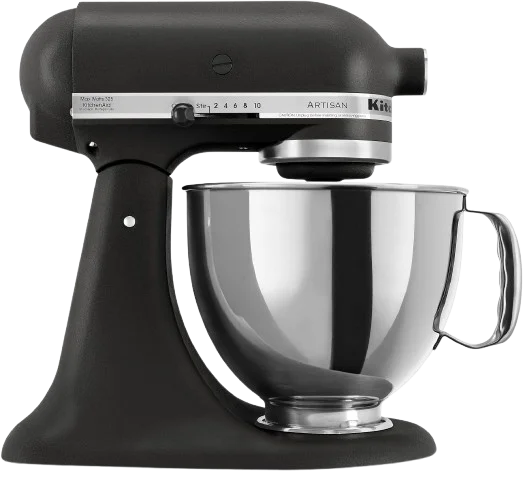
KitchenAid Artisan 5-Quart
Model: KSM150PS
A versatile planetary stand mixer for home bakers who want one appliance for mixing, beating, whipping, and occasional bread-making.
What we like
- Versatile for everyday baking tasks.
- Established range of compatible hub attachments.
- Convenient tilt-head design.
- Useful for cakes, cookies, frostings, and suitable dough recipes.
What to consider
- Its 5-quart bowl is smaller than the Cuisinart’s 5.5-quart bowl.
- Not intended to replace a dedicated high-capacity dough mixer.
- Follow the model’s manual for yeast-dough limits and mixing speeds.
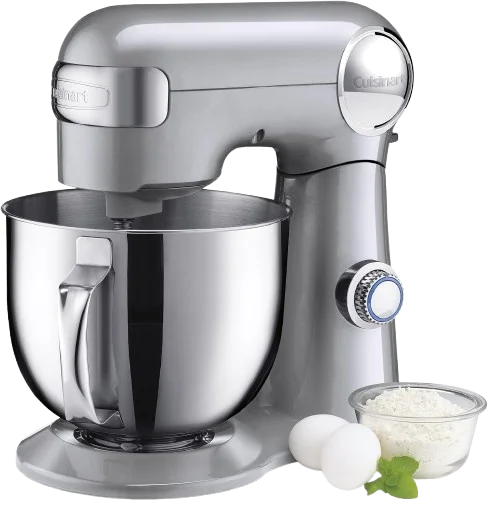
Cuisinart Precision Master 5.5-Quart
Model: SM-50
A multipurpose planetary stand mixer with a larger nominal bowl, 12 speed settings, and a power hub for optional accessories.
What we like
- Larger nominal bowl capacity than the Artisan.
- 12 speed settings.
- Includes a dough hook, flat paddle, and chef’s whisk.
- Power hub supports optional Cuisinart accessories.
What to consider
- The model has been discontinued by Cuisinart.
- Published independent tests have raised concerns about kneading performance and stability.
- Its US manual limits most bread and pizza yeast doughs to six cups of white flour.
- Replacement-part and warranty support should be checked before buying.
As an Amazon Associate, MixerDecoded earns from qualifying purchases. Product specifications and buying considerations are based on the cited model documentation and our published research.
In this article, we’ll cover:
KitchenAid vs Cuisinart Stand Mixer: Which Models Are We Comparing?
Before comparing performance, we need to establish which machines we’re discussing.
KitchenAid sells several stand mixer families, including tilt-head and bowl-lift models. Cuisinart has also produced multiple stand mixer ranges. Their specifications and capabilities shouldn’t be treated as interchangeable.
For this comparison, we’re using two recognizable tilt-head models:
- KitchenAid Artisan 5-quart: The reference KitchenAid model.
- Cuisinart Precision Master SM-50: The reference Cuisinart model.
This gives us a useful comparison between two similarly positioned household stand mixers. However, it doesn’t mean that every KitchenAid or Cuisinart model shares these specifications.
KitchenAid vs Cuisinart specifications
| Specification | KitchenAid Artisan 5-quart | Cuisinart Precision Master |
|---|---|---|
| Mixing design | Tilt-head, planetary action | Tilt-head, planetary action |
| Bowl capacity | 5 US quarts (approximately 4.73 L) | 5.5 US quarts (approximately 5.20 L) |
| Motor rating | 325 watts for the referenced Artisan specification | 500 watts |
| Speed settings | 10 | 12 |
| Mixing bowl | Stainless steel | Stainless steel |
| Included tools | Flat beater, dough hook and wire whisk; verify the exact package | Flat paddle, dough hook and chef’s whisk |
| Accessory connection | Front power hub | Front accessory outlet |
| Manufacturer status | Verify the exact model and regional listing | SM-50BC listed as discontinued but listed in Amazon |
Specifications are model-specific. Included accessories, finishes and product configurations can vary.
One difference immediately stands out: the Cuisinart has a higher stated wattage and a nominally larger bowl.
However, we wouldn’t use those two specifications to decide which mixer performs better. Motor wattage alone doesn’t tell us how effectively a mixer transfers power under load, and bowl capacity doesn’t tell us how well its mixing tool incorporates ingredients.
We need to examine the actual mixing design and performance evidence.
For more information, see our stand mixer buying guide.
Mixer Design: How Do KitchenAid and Cuisinart Differ?
Both reference models use a tilt-head design with planetary mixing action. This means their basic operating principles are similar, even though their housings, controls, bowls and individual components differ.
KitchenAid Artisan tilt-head design
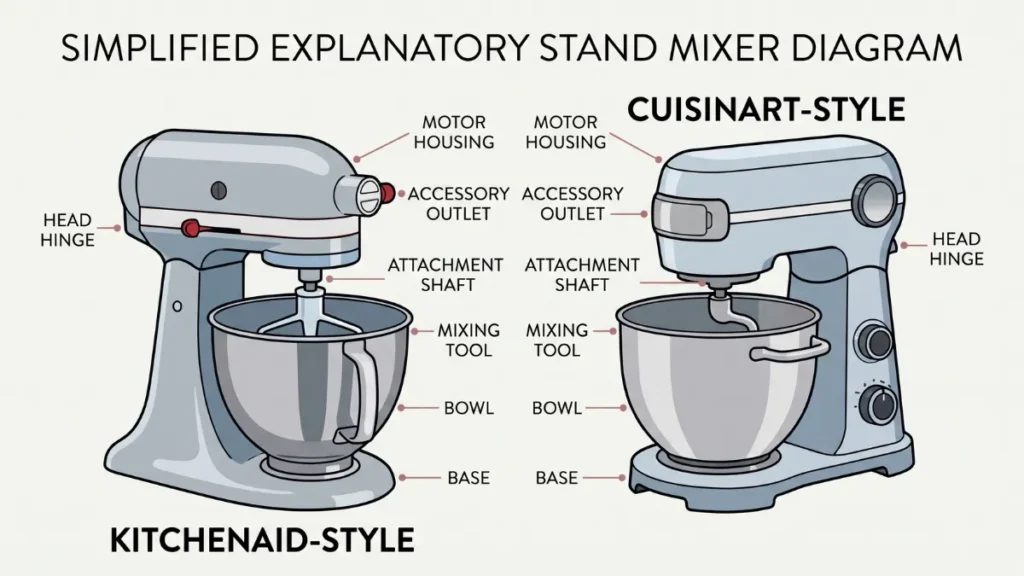
The KitchenAid Artisan has a motor head that tilts backward to provide access to the mixing bowl and attachment.
Its main components include:
- Motor housing
- Tilt-head hinge
- Head-locking mechanism
- Attachment shaft
- Mixing tool
- Stainless-steel bowl
- Bowl attachment points
- Front accessory power hub
- Base
The planetary action moves the mixing tool around the bowl while the tool rotates on its own axis. This helps distribute the mixing action across the ingredients.
One feature we consider particularly useful is KitchenAid’s front accessory hub. It allows compatible powered attachments to connect to the mixer, expanding its potential uses beyond ordinary mixing.
Cuisinart Precision Master tilt-head design
The Cuisinart SM-50 also uses a tilt-back head and planetary mixing action.
Its main components include:
- Motor housing
- Tilt-head hinge
- Head-locking mechanism
- Attachment shaft
- Mixing tool
- 5.5-quart stainless-steel bowl
- Bowl-locking position
- Front accessory outlet
- Base
The SM-50’s front outlet supports its own range of optional attachments. These include accessories such as pasta-making tools and a meat grinder, subject to the exact model’s compatibility documentation.
What do these design differences mean?
When we compare the two mixers, we pay attention to more than their external appearance.
We consider:
- Beater reach: How effectively does the mixing tool reach ingredients around the bowl?
- Bowl geometry: Does the shape of the bowl help incorporate small and large quantities?
- Head stability: Does the head remain secure during demanding mixing?
- Bowl attachment: How easily can the bowl be installed and removed?
- Accessory system: Are the tools and powered attachments useful for the recipes we prepare?
These details can influence everyday performance even when two mixers have similar-looking designs.
Which Cuisinart Precision Master Model Are We Comparing?
The Cuisinart mixer discussed in this comparison is the Precision Master SM-50BC, the variant associated with our existing SM-50 review. However, Cuisinart’s current US product listing identifies the Precision Master 5.5-Quart Stand Mixer as model SM-50NAS.
The two model identifiers should not be treated as interchangeable. Although their published specifications are similar, the available evidence does not establish that the SM-50NAS is a redesigned generation or that every component and accessory package is identical to the older SM-50BC.
If you are buying new, check Cuisinart’s current SM-50NAS listing and confirm the exact model number supplied by the retailer.
KitchenAid vs Cuisinart: Which Performs Better?
This is where we move beyond specifications.
A stand mixer that performs well when preparing cake batter may not be equally effective when kneading dense bread dough. We therefore assess the available evidence by task rather than assigning one overall performance winner.
1. Cake batter and creaming butter and sugar
For everyday cake baking, we’d give the KitchenAid Artisan serious consideration.
In its published comparison, Homes & Gardens reported that the KitchenAid performed better when creaming butter and sugar. Its reviewer also noted that the Cuisinart’s mixing tool did not incorporate the ingredients as effectively in the test.
This observation is important because creaming requires the mixing tool to work effectively against the bowl’s interior. A tool that doesn’t reach the ingredients consistently may require more manual intervention.
We wouldn’t conclude from one test that every KitchenAid model will outperform every Cuisinart model. However, the published result gives us a reason to examine bowl geometry and beater reach when comparing these particular machines.
Our assessment: We’d lean toward the KitchenAid Artisan for buyers who regularly prepare cakes and smaller batches of butter-and-sugar mixtures, based on the available published comparison.
2. Cookie dough and everyday mixing
Both brands offer stand mixers designed for everyday baking tasks.
When we compare them for cookie preparation, we’d look at:
- The manufacturer’s recommended batch capacity
- The shape and coverage of the flat beater
- How effectively ingredients are incorporated
- Whether the mixer remains stable with thicker mixtures
- How easily the user can scrape down the bowl when necessary
We wouldn’t assume that the Cuisinart’s larger bowl automatically makes it better for cookies. A larger bowl can be useful for bigger batches, but the relationship between the mixing tool and the bowl also matters.
For occasional cookies, cake batter and similar recipes, both models may be worth considering if their condition, price and accessory packages are suitable.
3. Bread dough and pizza dough
Bread dough is a more demanding test of a stand mixer.
Unlike cake batter, kneading creates sustained resistance. Dense dough can place considerable demands on the motor, transmission, mixing tool and machine stability.
This is why we don’t rank mixers for bread making by wattage alone.
The published comparisons also deserve careful interpretation. Homes & Gardens reported that its Cuisinart performed better than the KitchenAid Artisan in its bread-dough test. However, other independent reviews of the older Cuisinart SM-50 have reported difficulties with dough incorporation and movement during kneading.
We see these findings as evidence that results can depend on the recipe, quantity, machine condition and testing method. They don’t establish a universal winner.
There’s also an important manufacturer specification to consider.
Cuisinart’s US SM-50 manual specifies a maximum of six cups of white flour for most yeast dough recipes, including bread and pizza dough. This is a flour measurement, not the total finished dough weight.
We’d use that manufacturer limit when assessing the SM-50, rather than assuming its 5.5-quart bowl can handle any quantity of dough that physically fits inside it.
For anyone regularly making dense sourdough, pizza dough or large batches, we’d recommend comparing exact recipe limits and independent kneading tests before buying.
You can also use our guide to calculate your dough weight for a stand mixer before comparing a recipe with a manufacturer’s capacity recommendation.
Our assessment: We wouldn’t declare either reference model the clear bread-dough winner. The evidence is mixed, and the manufacturer’s capacity guidance should carry more weight than the motor wattage comparison.
4. Whipping cream and egg whites
Whipping performance depends on the whisk design, bowl geometry, ingredient quantity and speed settings.
Homes & Gardens reported similar results from the two mixers when whipping cream in its comparison.
This suggests that the Cuisinart’s higher motor rating doesn’t necessarily translate into better performance for every mixing task.
When choosing between them, we’d pay particular attention to the quantities you normally prepare. A mixer that performs well with a large batch may not necessarily be as effective with a very small quantity.
Our assessment: We wouldn’t choose between these brands based on whipping performance alone. Both deserve consideration, subject to the exact model and recipe quantity.
Can Cuisinart Stand Mixers Use KitchenAid Attachments?
We wouldn’t assume that Cuisinart and KitchenAid attachments are interchangeable.
Although both brands offer stand mixers with front accessory outlets, similar-looking connection points do not establish mechanical compatibility.
KitchenAid’s attachment compatibility information applies to its own compatible stand mixer models. It does not automatically establish that those accessories will fit or operate correctly on a Cuisinart mixer.
The Cuisinart SM-50 has its own accessory system. Cuisinart lists optional accessories for the relevant product family, including:
- Pasta roller and cutter
- Pasta extruder
- Meat grinder
- Frozen dessert maker
- Spiralizer
We also distinguish between two types of accessories:
Mixing tools: These include the dough hook, flat beater and whisk. They connect to the internal mixing mechanism.
Powered hub accessories: These include attachments such as pasta makers and meat grinders that connect to the front power outlet.
Even if an attachment appears to fit, we wouldn’t recommend using it without manufacturer confirmation. Differences in dimensions, locking mechanisms, clearances and operating loads can affect safe operation.
Our recommendation is to verify the exact mixer model and attachment part number before purchasing.
For more information, see our KitchenAid attachment compatibility guide.
Which Brand Offers Better Durability and Replacement-Part Support?
We wouldn’t judge durability from the motor rating or exterior construction alone.
Long-term ownership also depends on how frequently the mixer is used, the workload it handles, maintenance requirements, access to service and the availability of replacement components.
KitchenAid has a broad stand mixer range and an established accessory and parts ecosystem. However, replacement-part compatibility still needs to be checked against the exact model.
Cuisinart provides product-specific manuals and parts information, but availability can differ between product families and generations.
We’d also check:
- The applicable manufacturer warranty
- Whether the seller is authorized
- Whether the model is still supported
- The availability of replacement bowls and mixing tools
- The cost of any missing accessories
- Whether service is available in the buyer’s region
A longer warranty does not automatically prove that a mixer will last longer. We would compare the actual warranty terms and service arrangements for the exact products being considered.
For general guidance, see our stand mixer replacement parts guide.
KitchenAid vs Cuisinart Stand Mixer Reddit: What Do Owners Say?
When researching KitchenAid vs Cuisinart stand mixers, Reddit discussions provide another perspective beyond manufacturer specifications and professional product reviews.
Owners and prospective buyers often discuss questions that matter after purchase: whether KitchenAid justifies its higher price, how Cuisinart mixers perform during everyday baking, and whether either brand offers better long-term reliability.
We reviewed discussions from communities including r/Cooking, r/AskBaking and r/Baking. Here are the recurring themes.
1. KitchenAid’s reputation for longevity
In a 2023 r/Cooking discussion, several contributors described long-term experiences with KitchenAid mixers. Some reported owning machines for decades, while others pointed to the availability of replacement parts and the ability to repair older models.
These experiences help explain why some buyers are willing to pay more for a KitchenAid.
However, individual ownership experiences should not be treated as proof that every current KitchenAid model will last for decades. Product generations, usage patterns, maintenance and workload all matter.
2. Cuisinart can appeal to budget-conscious bakers
Cuisinart also receives positive comments from owners.
In an r/AskBaking discussion, one contributor described using a Cuisinart mixer for bread and pizza dough without problems. Another discussion in r/Baking included an SM-50 owner who reported satisfactory results with cookies and standard layer cakes.
This suggests that some owners find Cuisinart mixers perfectly suitable for ordinary home baking.
However, these are individual experiences rather than controlled performance tests. They do not establish that every Cuisinart model can handle every recipe or workload.
3. Is KitchenAid worth paying more for?
Price is one of the recurring questions in these discussions.
KitchenAid is often viewed as the more established choice, particularly by buyers who value its accessory ecosystem and perceived long-term serviceability. Cuisinart can be attractive to buyers who want a capable household mixer without spending as much.
The better value depends on the exact model, purchase price, included accessories, warranty, replacement-part availability and intended workload.
A lower purchase price does not necessarily mean a better long-term investment, just as a more expensive mixer is not automatically the better performer.
What Should You Take Away From Reddit?
Reddit owner discussions provide useful context, but they should not replace manufacturer documentation or independent product testing.
Our interpretation is:
- For long-term ownership: KitchenAid has a strong reputation among some long-term owners, but individual reports cannot guarantee the lifespan of current models.
- For everyday baking: Some Cuisinart owners report satisfactory results with cakes, cookies and bread.
- For value: Cuisinart may appeal to buyers with a tighter budget, while KitchenAid’s accessory ecosystem can be valuable to people who want additional functionality.
- For demanding dough: Check the exact model’s manufacturer limits and independent kneading tests instead of relying on brand reputation or Reddit comments.
You can read the original discussions in r/Cooking, r/AskBaking and r/Baking.
Our conclusion: Reddit discussions reinforce the importance of choosing a stand mixer according to your baking habits, budget and expectations. They do not provide enough evidence to declare KitchenAid or Cuisinart the universal winner. Our comparison of specifications, published performance tests and model-specific limitations remains the more reliable basis for making a purchase decision.
KitchenAid vs Cuisinart: Which Offers Better Value?
We think value should be judged by the complete ownership cost, not simply the price on the product listing.
When comparing the two brands, we’d consider:
- Initial purchase price
- Included mixing tools
- Bowl capacity
- Optional attachment costs
- Replacement-part availability
- Warranty coverage
- Whether the machine can handle the recipes we regularly prepare
KitchenAid’s accessory ecosystem may justify its price for someone who wants to use the mixer for more than ordinary mixing.
We’d therefore compare current prices only after confirming the exact model, seller, package contents and availability.
Which Stand Mixer Would We Recommend?
After examining the specifications, design differences and published testing, we’d make our recommendation according to the buyer’s needs.
We’d choose KitchenAid if…
- We wanted an all-purpose stand mixer for regular home baking.
- We valued the availability of compatible KitchenAid hub attachments.
- We wanted to compare different tilt-head and bowl-lift models.
- We preferred a broad range of model-specific support and accessories.
If you’ve decided to buy a KitchenAid, you can also compare the KitchenAid stand mixer Black Friday deals on Amazon to explore the available models and finishes.
The Artisan is a useful starting point for everyday home baking. However, if we regularly prepare large batches or dense dough, we’d also compare KitchenAid’s bowl-lift models.
We’d consider Cuisinart if…
- We had identified a specific Cuisinart model that suited our recipes.
- Its bowl capacity and included tools matched our needs.
- We had verified its current availability and parts support.
- The purchase price represented good value after accounting for its condition and accessories.
When we’d look beyond both brands
We wouldn’t limit our search to KitchenAid and Cuisinart if our primary requirement were demanding bread or pizza dough preparation.
Bosch and Ankarsrum are worth researching for certain bread-making workloads, while Ooni’s spiral mixers are relevant to buyers whose main focus is pizza and bread dough.
The right alternative depends on batch size, dough hydration, frequency of use, available counter space and budget.
Our best stand mixers for bread dough guide provides a more focused comparison for that particular workload.
Frequently Asked Questions
Which brand is better, KitchenAid or Cuisinart?
We wouldn’t declare either brand universally better. KitchenAid offers a broad stand mixer range and accessory ecosystem, while Cuisinart has produced competitive household mixers with useful features. We recommend comparing the exact models and the tasks you expect them to handle.
Are Cuisinart stand mixers as good as KitchenAid?
Some Cuisinart models can compete with KitchenAid models for particular tasks. However, published comparisons have reported different results for cake mixing and bread kneading. We’d assess each model individually rather than assume that one brand always performs better.
Are KitchenAid and Cuisinart the same company?
No. KitchenAid and Cuisinart are separate appliance brands. Their stand mixers may share design characteristics, but their specifications, accessories, manufacturing arrangements and compatibility requirements are not interchangeable.
What stand mixer is better than KitchenAid?
We don’t think there is one universal replacement for KitchenAid. Bosch and Ankarsrum are worth comparing for certain bread-making requirements, while other brands may offer better value for occasional baking. The best alternative depends on which KitchenAid model you’re comparing and what you need the mixer to do.
Are Cuisinart stand mixers good?
Cuisinart has produced stand mixers with useful features, including tilt-head designs, stainless-steel bowls and optional attachments. We’d judge a particular model by its documented capacity, published performance evidence, price, condition and parts availability.
Is KitchenAid really the best stand mixer?
KitchenAid is a strong option for many home bakers, particularly those who value versatility and its accessory ecosystem. However, we wouldn’t call it the best choice for every workload. Some alternatives may be better suited to frequent bread kneading, larger batches or specific budgets.
Can Cuisinart mixers use KitchenAid attachments?
We wouldn’t assume they can. KitchenAid’s compatibility guidance applies to compatible KitchenAid stand mixers. Cuisinart mixers have their own accessory systems, so we recommend checking the exact model and attachment compatibility with the manufacturer before purchasing.
Our Final Verdict: KitchenAid vs Cuisinart
After comparing the available specifications, product designs and independent reviews, we’d lean toward the KitchenAid Artisan as the more straightforward all-purpose recommendation for home baking, particularly for buyers who value its accessory ecosystem.
However, we wouldn’t dismiss Cuisinart simply because KitchenAid is more familiar. The Precision Master SM-50 has a larger nominal bowl and a higher stated motor rating than the referenced Artisan. Those are useful specifications, but they don’t establish superior kneading, mixing or long-term durability.
For us, the most important buying consideration is matching the exact mixer to the work it needs to perform.
If we were choosing a mixer for everyday cakes, cookies and general baking, we’d shortlist KitchenAid. If we were considering the Cuisinart SM-50, we’d first verify its condition, included tools, parts availability and suitability for our recipes.