The best stand mixers aren’t necessarily the biggest, most powerful, or most expensive models you can buy.
The right mixer depends on what you make, how much you make, how often you bake, and how much space you have available. A compact mixer can be a better choice for occasional bakers, while frequent bread bakers may benefit from a mixer designed specifically around heavy dough.
There is also more than one type of stand mixer. Traditional planetary mixers such as KitchenAid’s tilt-head and bowl-lift models are designed for a wide range of everyday mixing jobs. Spiral mixers take a different approach and can make more sense if bread and pizza dough are your primary concern.
This guide compares several stand mixers and mixer architectures to help you choose based on real kitchen use rather than wattage or marketing claims alone.
Quick Answer: Which Stand Mixer Is Best?
For most home bakers who want one versatile mixer for cookies, cakes, frosting, and occasional bread, the KitchenAid Artisan 5-Quart KSM150PS is our leading overall choice.
It combines a 5-quart bowl with a tilt-head design and 10 speeds, making it a versatile option for a wide range of everyday baking tasks. KitchenAid includes a stainless steel bowl, coated flat beater, coated dough hook, six-wire whip, and pouring shield.
But it isn’t the best choice for everyone.
- Best Overall: KitchenAid Artisan 5-Quart KSM150PS
- Best Compact: KitchenAid Artisan Mini KSM3316XBM
- Best for Large Batches: KitchenAid 7-Qt Bowl-Lift KSM70SKXX
- Best for Bread and Dough: Bosch Universal Plus Stand Mixer
- Best Spiral Mixer: Ooni Halo Pro
- Best Compact Dough-Focused Mixer: Ooni Halo Core
The important point is that these aren’t six versions of the same idea. The KitchenAid models use planetary mixing, while the Bosch and Ooni machines use different mixing architectures that can appeal particularly to bread and pizza bakers.
In this article, we’ll cover:
Pro Tip: Don’t Choose a Stand Mixer by Wattage Alone
Motor wattage is an easy specification to compare, but it doesn’t tell you everything about how a mixer will perform.
Transmission, bowl geometry, mixing action, speed control, attachment design, and the type of workload the machine is designed to handle can all affect the experience.
For example, a mixer designed around bread dough doesn’t necessarily need to resemble a conventional planetary stand mixer. The mixing mechanism itself can change how the machine handles dough.
When comparing mixers, start with your workload rather than starting with the wattage number.
Our Top Stand Mixer Picks
Best Overall: KitchenAid Artisan 5-Quart KSM150PS
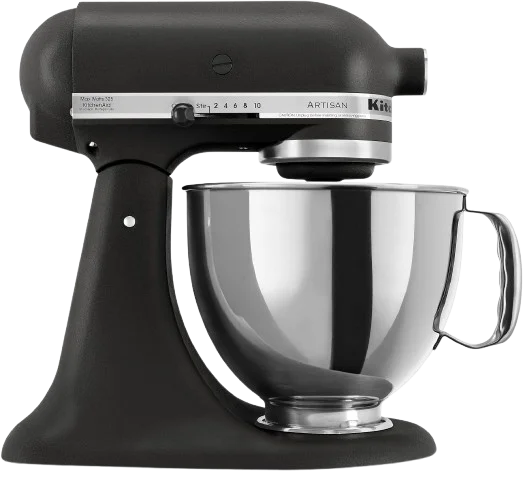
The KitchenAid Artisan 5-Quart KSM150PS is our leading choice for the home baker who wants one versatile mixer for a broad range of everyday tasks.
It has a 5-quart bowl, tilt-head design, and 10 speeds. KitchenAid includes a stainless steel bowl, coated flat beater, coated dough hook, six-wire whip, and pouring shield.
Why we recommend it
The Artisan sits in a useful middle ground.
Its 5-quart capacity is substantial enough for many everyday home-baking tasks without moving immediately into the larger bowl-lift format of a heavy-duty mixer.
The familiar planetary mixing design also makes it a practical general-purpose choice for households that prepare a mixture of cookies, cakes, frosting, whipped mixtures, and dough.
Best for
- Cookies and cakes
- Frosting and whipped mixtures
- Everyday home baking
- Bakers who want one versatile machine
- Users who expect to use their mixer regularly
Keep in mind
A 5-quart tilt-head mixer isn’t automatically the right answer for very large batches or a kitchen where bread dough is the dominant workload.
If you routinely make large quantities or work with substantial amounts of heavy dough, a bowl-lift or spiral mixer may make more sense.
Our verdict: A strong all-purpose choice for the typical home baker who wants a versatile 5-quart planetary mixer.
Best Compact Stand Mixer: KitchenAid Artisan Mini KSM3316XBM
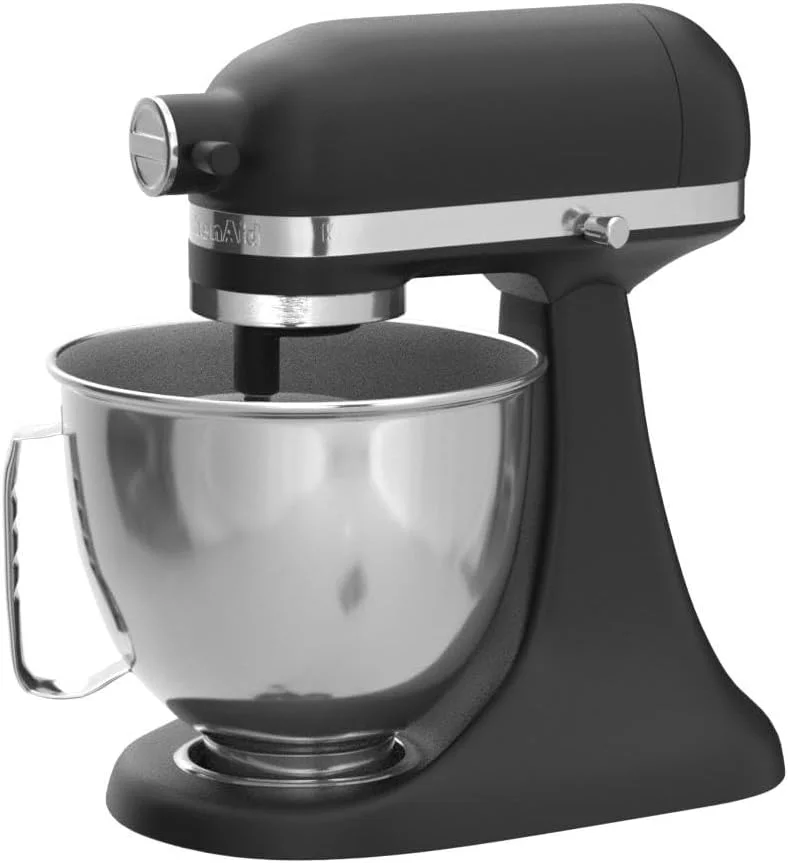
The KitchenAid Artisan Mini KSM3316XBM is the better fit when counter space and batch size matter more than maximum capacity.
It has a 3.5-quart bowl, tilt-head design, and 10 speeds. KitchenAid states that the mixer can handle up to five dozen cookies under its specified testing conditions.
Why we recommend it
The Mini preserves the familiar KitchenAid planetary-mixer format while reducing the overall size of the machine.
That makes it particularly appealing for:
- Small kitchens
- Apartment kitchens
- Occasional bakers
- Smaller households
- Bakers who rarely make large batches
Keep in mind
The smaller bowl is also the reason to choose this model carefully.
If you regularly double recipes or make large batches of dough, the Mini’s compact design becomes a limitation rather than an advantage.
Our verdict: One of the better choices when you want a genuine stand mixer but don’t need a large bowl.
Best for Large Batches: KitchenAid 7-Qt Bowl-Lift KSM70SKXX
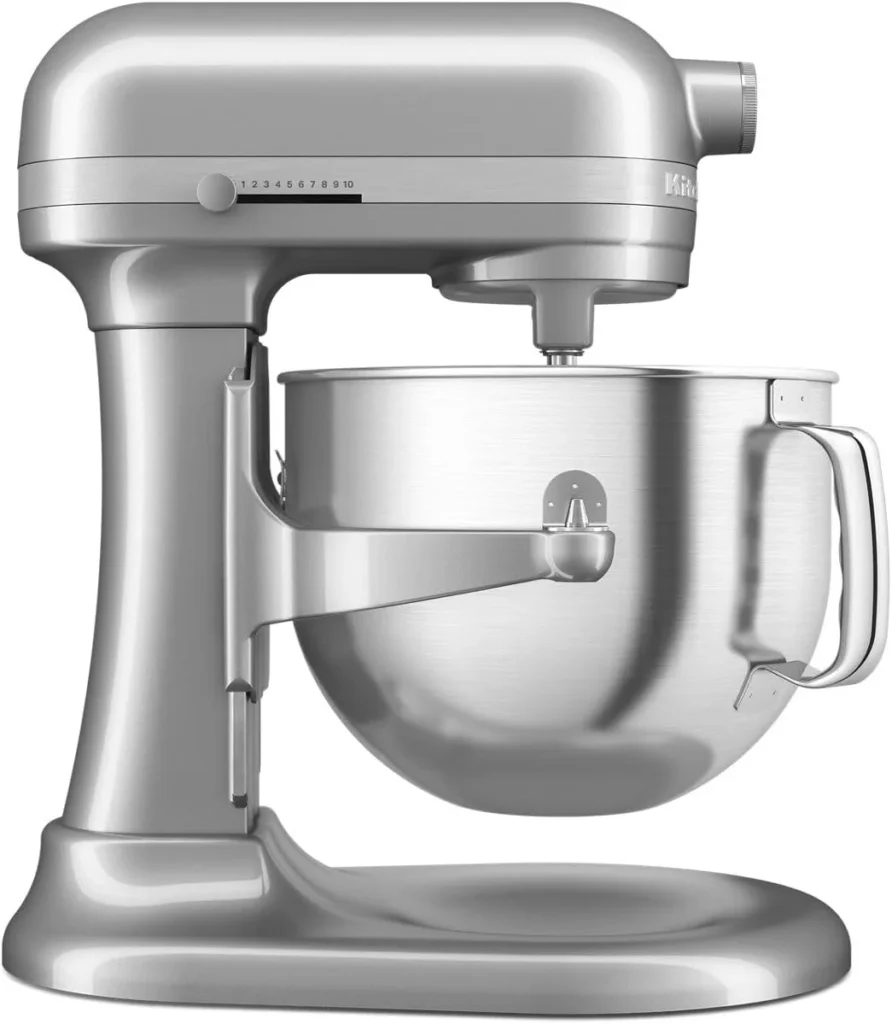
If your priority is larger batches and heavier workloads, the KitchenAid 7-Qt Bowl-Lift KSM70SKXX moves into a different class from the compact and standard tilt-head models.
This model uses a 7-quart bowl-lift design and 11 speeds. KitchenAid also lists accessories and manufacturer-stated capacity examples intended for substantial baking workloads.
Why we recommend it
A bowl-lift mixer is particularly useful when you’re working with a larger, heavier load. Instead of tilting the mixer head backward, the bowl is raised into position beneath the fixed mixer head.
That architecture can also provide a more substantial feel when working with larger quantities.
Best for
- Large cookie batches
- Larger cake recipes
- Frequent baking
- Bakers who routinely scale recipes
- Users who want more capacity than a typical 5-quart tilt-head
Keep in mind
More capacity also means a larger machine.
If you mostly make small batches, a 7-quart bowl may be unnecessary, and the additional counter and storage requirements may outweigh its advantages.
Our verdict: The better choice when your baking volume regularly pushes beyond what a typical 5-quart mixer comfortably suits.
Best for Bread and Dough: Bosch Universal Plus Stand Mixer
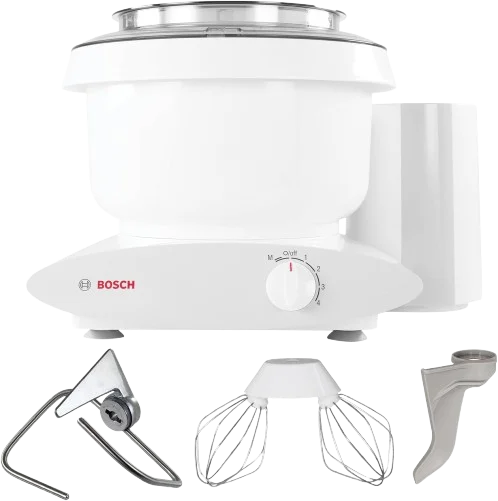
The Bosch Universal Plus Stand Mixer deserves special consideration if bread and heavy doughs are the primary reasons you’re buying a mixer.
Unlike conventional tilt-head or bowl-lift planetary mixers, the Bosch features a bottom-drive architecture with an open-top 6.5-quart bowl. The bowl remains locked in place while dual-action attachments (including a specialized heavy-duty dough hook) spin around a central drive shaft. Manufacturer ratings indicate it can knead up to 14–15 lbs of heavy dough without straining.
Why we recommend it
- Bottom-Drive Power: Placing the motor underneath the unit opens up the entire top of the bowl, making it effortless to add ingredients while mixing.
- Superior Kneading Performance: The dual-head mechanism and specialized dough hook mimic hand-kneading, developing gluten fast and efficiently.
- Exceptional High-Volume Capacity: Ideal for serious home bakers who routinely mix multi-loaf batches.
Best for
- High-volume bread and sourdough bakers
- Large dough batches and pizza dough
- Anyone frequently preparing heavy yeast doughs
Keep in mind
- Learning Curve: Because the central shaft sits inside the bowl, cleaning around the center column requires a slightly different routine than a smooth traditional mixing bowl.
- Different Operating Experience: If you are accustomed to a classic KitchenAid-style top-drive mixer, the bottom-drive system may take a few uses to get comfortable with.
Our Verdict: A top-tier, heavy-duty alternative to traditional planetary mixers, making it a compelling option for serious, dough-focused home bakers.
Best Spiral Mixer: Ooni Halo Pro
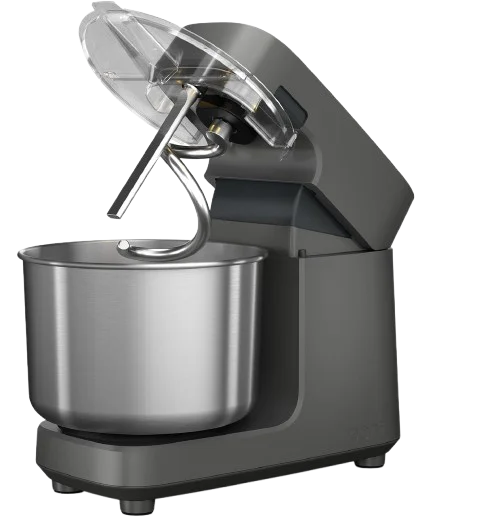
The Ooni Halo Pro is another fundamentally different option.
It is a spiral mixer with a 7.3-quart/7-liter bowl and 58 speed settings. Ooni lists a 650W DC motor and a manufacturer-specified dough range of approximately 1 to 5 kg.
Why we recommend it
The Halo Pro is particularly interesting for users whose mixer workload revolves around dough.
Its spiral mixing architecture is designed around the interaction between the bowl and spiral hook rather than the planetary action found in traditional KitchenAid-style mixers.
Best for
- Pizza dough
- Bread dough
- Sourdough
- Frequent dough mixing
- Users interested in spiral mixing
Keep in mind
This isn’t the obvious choice if your primary workload is cake batter, frosting, whipped cream, and cookies.
It is better considered when dough is central to your baking routine.
Our verdict: A strong option for dough-focused users who specifically want a spiral mixer rather than a conventional planetary stand mixer.
Best Compact Dough-Focused Mixer: Ooni Halo Core
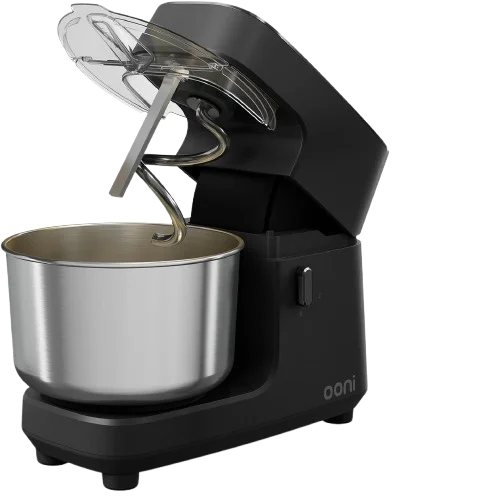
The Ooni Halo Core takes the spiral-mixer concept into a smaller format.
It has a 4.8-quart/4.5-liter bowl, 20 speed settings, and dual DC motors. Ooni specifies a dough range from 500 g to 2.5 kg.
Why we recommend it
The Halo Core makes more sense than the larger Halo Pro when your dough batches are smaller and you don’t need the latter’s capacity.
Ooni positions it as a more compact mixer, and the manufacturer states that it is smaller and lighter than the Halo Pro.
Best for
- Pizza dough
- Smaller bread batches
- Home pizza makers
- Dough-focused users with limited space
- Users who prefer spiral mixing
Keep in mind
Its dough-focused design doesn’t automatically make it a better general-purpose mixer than a conventional planetary machine.
If you make substantially more cakes and cookies than bread or pizza, a traditional planetary mixer may be the more natural fit.
Our verdict: An interesting middle ground for home bakers who prioritize dough but don’t need a large spiral mixer.
How We Evaluate Stand Mixers
A useful stand-mixer recommendation should go beyond comparing motor wattage or counting the number of speeds.
For each mixer, we look at the factors that actually affect the buying decision:
- Mixer architecture: planetary, spiral, or another design
- Bowl capacity: how much food the mixer is designed to handle
- Typical workload: cakes and cookies versus bread and pizza dough
- Batch size: whether the machine suits small, medium, or large recipes
- Controls and speed range: how much control the user gets over mixing
- Attachments: what comes with the mixer and what is available separately
- Counter space: footprint, height, and practical storage considerations
- Ease of use: bowl access, tool changes, controls, and everyday handling
- Price: whether the machine’s capabilities make sense for the intended workload
We also separate manufacturer-confirmed specifications from our own editorial conclusions.
For example, a manufacturer can establish a mixer’s bowl capacity, speed settings, motor specification, and stated dough capacity. Calling that mixer “best for bread” or “best overall,” however, is an editorial judgment based on how those characteristics fit a particular user’s needs.
How to Choose the Right Stand Mixer
The easiest way to choose a stand mixer is to work backward from your kitchen.
Don’t start with the mixer. Start with what you need the mixer to do.
1. What Do You Usually Make?
Your recipes are one of the strongest indicators of which mixer makes sense.
Mostly cakes, cookies, and frosting
A conventional planetary mixer is usually the most straightforward choice.
KitchenAid’s tilt-head mixers, for example, are designed around a broad range of everyday mixing tasks, while the company’s accessory system can expand the machine’s functionality beyond the included mixing tools.
Mostly bread and pizza dough
The decision becomes more interesting.
You may want to consider a larger bowl-lift planetary mixer, but dedicated dough-focused machines such as the Bosch or Ooni’s Halo spiral mixers are also worth considering.
A mixture of everything
This is where a versatile 5-quart planetary mixer makes the most sense for many households.
You get a machine that can handle everyday baking while leaving the door open to additional attachments and accessories.
2. How Large Are Your Batches?
Bowl capacity matters, but bowl capacity and usable workload are not the same thing.
A larger bowl doesn’t automatically mean you should fill it to the top. Different foods require different amounts of working room, and manufacturers may specify different maximum quantities for different recipes.
KitchenAid’s own comparison material, for example, gives different manufacturer-stated capacities for different mixer sizes and recipes.
Think about your normal batch rather than the largest recipe you might make once a year.
A useful starting point
| Typical workload | Mixer direction |
|---|---|
| Small batches and occasional baking | Compact 3.5-quart class |
| Everyday home baking | Around 5-quart class |
| Frequent large batches | 6- to 7-quart bowl-lift class |
| Large amounts of bread or pizza dough | Consider a dough-focused or spiral mixer |
These are buying guidelines, not universal capacity limits. Always check the manufacturer’s specifications for the exact model and recipe.
3. Do You Want a Tilt-Head or Bowl-Lift Mixer?
This choice is more important than it may initially appear.
Tilt-head
A tilt-head mixer allows the mixer head to tilt backward so you can access the bowl and change attachments.
This design is common on smaller and mid-size household mixers.
Advantages:
- Easy bowl access
- Convenient attachment changes
- Familiar everyday operation
- Often a good fit for general home baking
Potential drawbacks:
- Can be less convenient for very large workloads
- Requires overhead clearance for the head to tilt
Bowl-lift
A bowl-lift mixer keeps the mixer head fixed while the bowl moves upward into position.
KitchenAid uses this architecture on several of its larger mixers.
Advantages:
- Well suited to larger bowls
- Useful for larger and heavier workloads
- Fixed mixer head can feel substantial during demanding mixing
Potential drawbacks:
- Larger overall machine
- Less convenient if you frequently need to remove the bowl
- More counter space may be required
There isn’t a universal winner.
If you mostly bake ordinary-sized batches, a tilt-head may be more convenient. If you routinely work with large quantities, a bowl-lift design becomes more attractive.
For a more detailed comparison, see our guide to tilt-head vs. bowl-lift stand mixers.
Planetary vs. Spiral Mixers

This is one of the most important distinctions when comparing the machines in this guide.
Planetary Mixers
A planetary mixer uses a mixing attachment that moves around the bowl while also rotating on its own axis.
This is the familiar architecture used by KitchenAid’s household stand mixers.
It is versatile and works well for tasks such as:
- Cake batter
- Cookies
- Frosting
- Whipped mixtures
- Many bread and pizza doughs
For a household that wants one machine for many different recipes, planetary mixing is a practical general-purpose approach.
Spiral Mixers
A spiral mixer uses a different mixing mechanism, with the spiral hook and bowl working together to develop dough.
This architecture is particularly associated with bread and pizza production.
The Ooni Halo Pro and Halo Core are examples of spiral mixers, while the Bosch uses its own rotating-bowl architecture rather than conventional planetary mixing.
Which is better?
Neither architecture is universally better.
Choose planetary if:
- You make lots of different types of recipes
- Cakes and cookies are important
- You want a general-purpose household mixer
- You value a broad attachment ecosystem
Consider spiral or dough-focused designs if:
- Bread is a major part of your routine
- Pizza dough is a frequent workload
- You regularly make substantial dough batches
- Dough handling is more important than general-purpose mixing
This is why comparing an Ooni Halo Pro directly with a KitchenAid Artisan as if they were identical products can be misleading. They solve overlapping problems but are designed around different mixing priorities.
How Much Stand Mixer Capacity Do You Need?
Capacity is one of the easiest specifications to understand and one of the easiest to misuse.
A 7-quart mixer isn’t necessarily “better” than a 5-quart mixer. It is simply designed to give you more bowl capacity.
If your typical recipes are small, the larger mixer can add unnecessary size and cost.
If you regularly make double batches, large cookie recipes, or substantial quantities of dough, however, the additional capacity can be valuable.
Choose based on your normal workload
3.5-quart: Best when compactness and small batches are priorities.
Around 5 quarts: A versatile range for many home bakers.
6–7 quarts: More appropriate when larger batches are routine.
7 liters and above: Particularly interesting for users whose main concern is substantial dough production, although bowl volume alone does not determine actual dough capacity.
The manufacturer’s stated maximum quantities should always take priority over a simple quart-to-quart comparison.
Is the KitchenAid Artisan 5-Quart Right for You?
The KitchenAid Artisan KSM150PS is a sensible choice if you want a conventional 5-quart planetary mixer for general home baking.
It has a 5-quart bowl, tilt-head design, and 10 speeds, with a stainless steel bowl and the core mixing tools included by KitchenAid.
Choose the Artisan if:
- You want a general-purpose mixer
- You regularly make cookies and cakes
- You want a 5-quart bowl
- You prefer a tilt-head design
- You want access to KitchenAid’s broader attachment ecosystem
Consider another mixer if:
- You routinely make very large batches
- Bread and pizza dough dominate your workload
- You need a particularly compact machine
- You specifically want spiral mixing
The Artisan isn’t the largest or most specialized mixer in this guide. That’s precisely why it works well as an overall recommendation: it occupies a useful middle ground for general home baking.
Do You Need a Stand Mixer?
Not every kitchen needs one.
A stand mixer is most useful when it saves you meaningful effort or makes a workload easier to repeat.
You may benefit from one if you:
- Bake regularly
- Make bread or pizza dough frequently
- Prepare large batches
- Make cookies or cakes in quantity
- Want hands-free mixing
- Use mixing attachments regularly
A stand mixer may be unnecessary if you:
- Bake only a few times a year
- Usually make very small batches
- Have limited storage space
- Don’t make recipes that require extended mixing
- Already own a hand mixer that handles your normal workload
For occasional baking, a hand mixer can be the more economical and space-efficient choice.
For frequent baking, a stand mixer becomes more compelling because the machine can perform the mixing while you prepare the next part of the recipe.
For a more detailed comparison, see our guide to hand mixers vs. stand mixers.
Which Stand Mixer Should You Buy?
The simplest way to narrow down the choices is to match the mixer to your actual workload.
| If you… | Consider |
|---|---|
| Want one versatile mixer for everyday baking | KitchenAid Artisan 5-Quart KSM150PS |
| Have a small kitchen or usually make small batches | KitchenAid Artisan Mini KSM3316XBM |
| Regularly make large batches | KitchenAid 7-Qt Bowl-Lift KSM70SKXX |
| Primarily bake bread and work with substantial dough | Bosch Universal Plus Stand Mixer |
| Primarily make bread or pizza and want a spiral mixer | Ooni Halo Pro |
| Want a smaller dough-focused spiral mixer | Ooni Halo Core |
The best choice is therefore not simply the mixer with the largest bowl or the highest number on its motor specification.
It’s the machine whose architecture, capacity, and workload match the way you actually cook.
Frequently Asked Questions
What is the best stand mixers for most home bakers?
For many home bakers, a 5-quart planetary mixer is a practical starting point because it offers a useful balance of capacity and versatility. Our current overall pick is the KitchenAid Artisan 5-Quart KSM150PS, although the best choice depends on your recipes, batch sizes, and budget.
Is a 5-quart stand mixer big enough?
For many everyday home-baking tasks, yes. A 5-quart mixer is a versatile size for cookies, cakes, frosting, and many other recipes. However, the appropriate workload depends on the specific recipe and manufacturer’s stated capacity limits. If you regularly make large batches, a 6- or 7-quart mixer may be more appropriate.
Is a tilt-head or bowl-lift mixer better?
Neither is universally better. A tilt-head mixer is generally convenient for everyday use because the head moves out of the way when accessing the bowl. A bowl-lift mixer keeps the head fixed and raises the bowl into position, an architecture commonly used on larger KitchenAid models.
Is a higher-wattage stand mixer better?
Not necessarily. Motor wattage is only one specification. Mixing mechanism, transmission, speed control, bowl design, and the workload the machine is designed to handle can all matter. Compare the complete machine, not one number on the specification sheet.
What is the best stand mixers for bread dough?
There isn’t one universal answer. For a conventional planetary mixer, a larger bowl-lift model can be useful for substantial batches. If bread and pizza dough are the primary reason you’re buying a mixer, dedicated dough-focused machines such as the Bosch Universal Plus Stand Mixer or Ooni Halo Pro are worth considering because they use different mixing architectures.
Is the KitchenAid Artisan a good stand mixer?
The KitchenAid Artisan KSM150PS is a versatile 5-quart tilt-head mixer with 10 speeds and a range of included mixing tools. It is a strong fit for general home baking, particularly when you want a conventional planetary mixer rather than a dough-focused spiral design.
Is a stand mixer worth buying for occasional baking?
It depends on how often you bake and what you make. If you bake only occasionally and usually prepare small batches, a hand mixer may provide enough capability without the cost and counter space of a stand mixer. A stand mixer becomes more useful when you bake frequently, make larger batches, work with dough, or want hands-free mixing.
Can KitchenAid stand mixer attachments fit every KitchenAid mixer?
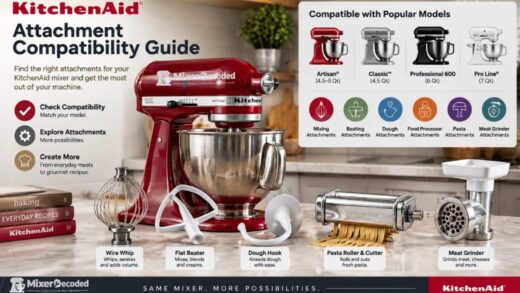
No. Do not assume that every KitchenAid attachment is compatible with every KitchenAid mixer. KitchenAid’s current accessory system includes compatibility distinctions for different mixer categories and sizes, including 3.5-quart Mini tilt-head, 5-quart tilt-head, and bowl-lift configurations. Always check the manufacturer’s compatibility information for the exact mixer model and attachment before purchasing.
Final Verdict About The Best Stand Mixers
For the typical home baker who wants one versatile machine for cakes, cookies, frosting, and general baking, the KitchenAid Artisan 5-Quart KSM150PS is our leading overall choice.
But different kitchens have different priorities.
- Choose the KitchenAid Artisan 5-Quart KSM150PS if keeping the mixer compact is more important than maximum capacity.
- Choose the KitchenAid 7-Qt Bowl-Lift KSM70SKXX if large batches are a regular part of your baking.
- Choose the Bosch Universal Plus Stand Mixer if bread and substantial dough workloads are the center of your mixing routine.
- Choose the Ooni Halo Pro if you specifically want a larger spiral mixer for dough-focused work.
- And consider the Ooni Halo Core if you want the spiral-mixer approach in a smaller format.
The key is not to shop for the biggest mixer you can afford.
Shop for the mixer that fits the food you actually make.
If you’re still deciding, start with our stand mixer buying guide to work through capacity, mixer type, dough requirements, attachments, and budget before choosing a model.
Last Updated on October 14, 2026 by Susan Joy