The KitchenAid Artisan Mini review question is less about whether this is a capable stand mixer and more about whether its smaller size matches the way you bake.
The KitchenAid Artisan Mini KSM3316XBM is a 3.5-quart tilt-head stand mixer designed for smaller batches and kitchens where counter space matters. It has 10 speeds, a stainless-steel bowl, three included mixing tools, and KitchenAid’s accessory hub for optional attachments.
The trade-off is straightforward: you get a more compact mixer, but you also get less bowl capacity than the 5-quart KitchenAid Artisan. For occasional bakers and smaller households, that can be an advantage. For frequent large-batch baking, it can become a limitation.
Reviewed by the MixerDecoded Editorial Team
Research, specifications, and product claims are checked against manufacturer documentation and independent sources. Hands-on testing findings are identified separately where applicable. See our Review Process →
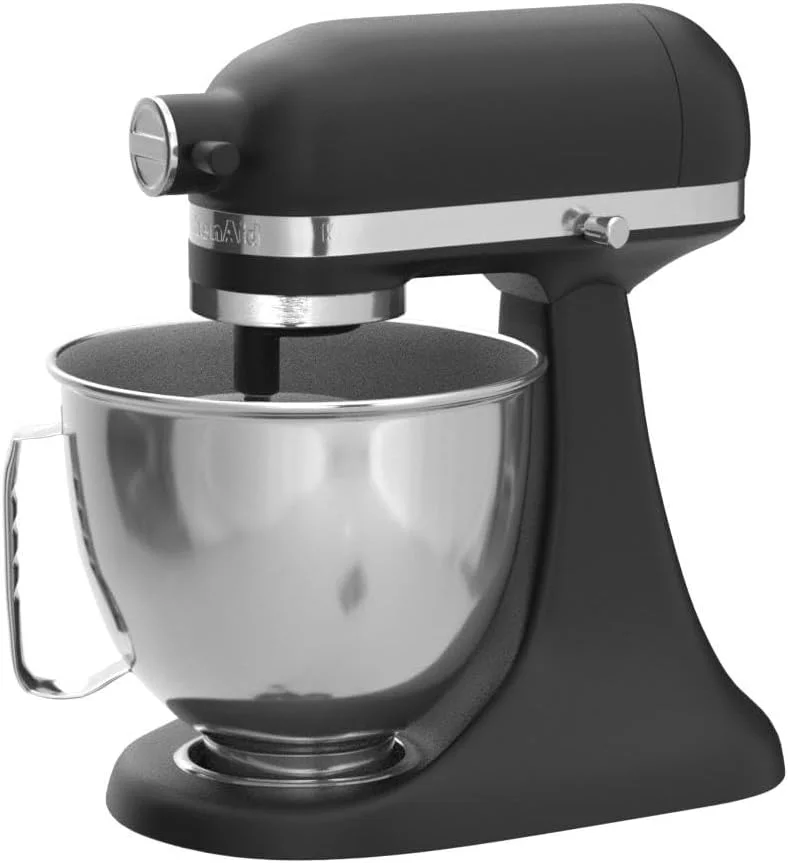
KitchenAid Artisan Mini 3.5-Quart Stand Mixer
Model KSM3316XBM · Tilt-Head Stand Mixer
A compact 3.5-quart stand mixer designed for smaller-batch baking, with 10 speeds, a stainless-steel bowl, and access to KitchenAid’s powered attachment hub.
Pros
- Compact size for smaller kitchens
- Well suited to smaller batches
- Access to KitchenAid’s attachment ecosystem
Cons
- Less capacity than the 5-quart Artisan
- Less suitable for consistently large batches
As an Amazon Associate, MixerDecoded earns from qualifying purchases.
In this article, we’ll cover:
KitchenAid Artisan Mini Review: At a Glance
| Feature | KitchenAid Artisan Mini KSM3316XBM |
|---|---|
| Mixer type | Tilt-head stand mixer |
| Bowl capacity | 3.5 quarts |
| Bowl material | Stainless steel |
| Speeds | 10 |
| Finish | Black Matte |
| Dimensions | 12.3″ D × 7.8″ W × 15.7″ H |
| Gross weight | 18.4 lb |
| Included mixing tools | Flex Edge beater, coated dough hook, 6-wire whip |
| Attachment system | Power hub for optional attachments |
| Warranty | 1 year |
KitchenAid lists the Artisan Mini as a 3.5-quart tilt-head mixer with 10 speeds and a stainless-steel bowl. The manufacturer also positions the model as a smaller and lighter option for smaller batches and kitchens with limited counter space.
What Is the KitchenAid Artisan Mini?
The KitchenAid Artisan Mini is the smaller member of KitchenAid’s Artisan-style tilt-head lineup.
The KSM3316XBM has a 3.5-quart stainless-steel bowl and a tilt-head design. Tilting the mixer head back provides access to the bowl and makes it easier to change the included mixing tools.
The mixer provides 10 speed settings, giving you the same basic speed-control concept found across KitchenAid’s conventional stand-mixer lineup.
The included tools are a Flex Edge beater, coated dough hook, and 6-wire whip. The mixer also uses KitchenAid’s powered accessory hub, so compatible attachments can extend its functionality beyond mixing.
That makes the Artisan Mini more than simply a smaller appliance. It is a compact entry point into KitchenAid’s broader stand-mixer and attachment ecosystem.
What Is the KitchenAid Artisan Mini Good For?
The most important question in this KitchenAid Artisan Mini review is what the 3.5-quart capacity means in practical terms.
The Mini makes the most sense for cooks and bakers who generally work with smaller quantities.
Cakes and cake batter
A 3.5-quart bowl provides enough capacity for many everyday baking jobs without requiring a full-size stand mixer.
For someone who normally makes standard-size recipes rather than repeatedly doubling them, the smaller bowl can be a reasonable fit.
Cookies
KitchenAid states that the Artisan Mini can make up to five dozen cookies in one batch under its specified test conditions, using the flat beater and 28-gram portions.
That is useful as a manufacturer-provided reference point, but it should not be interpreted as a universal capacity figure for every cookie recipe. Ingredient density, dough consistency, recipe proportions, and portion size can all affect the amount a mixer can reasonably process.
Frosting and whipped mixtures
The included wire whip makes the Mini suitable for recipes that require whipping or aerating ingredients.
Again, the important consideration is batch size. A smaller bowl is an advantage when your recipes are modest in scale, but it gives you less room to grow than a larger stand mixer.
Smaller dough batches
The Artisan Mini includes a coated dough hook, so it can handle dough-mixing tasks within the manufacturer’s intended capacity.
However, buyers who regularly make large quantities of bread dough should look beyond bowl size alone and consider a mixer designed around their particular dough workload.
For larger quantities of bread and dough, see our guide to the best mixers for bread.
Where the KitchenAid Artisan Mini Falls Short
The Mini’s biggest limitation is also the reason it exists: capacity.
A 3.5-quart mixer gives you less room than a 5-quart Artisan. That difference may not matter for a small household, but it becomes increasingly important if you regularly:
- Double cookie or cake recipes
- Make large quantities for family gatherings
- Bake frequently for other people
- Work with larger dough batches
- Expect your baking workload to increase over time
This is where the Mini requires more careful consideration than its compact footprint might suggest.
A smaller mixer can be the better choice when the smaller bowl matches your recipes. It is not automatically the better choice simply because it takes up less space.
If you are unsure how much capacity you actually need, our stand mixer capacity guide is the better place to start.
KitchenAid Artisan Mini vs. KitchenAid Artisan
The most important comparison for many shoppers is the KitchenAid Artisan Mini vs. Artisan.
The full-size Artisan has a 5-quart bowl, while the Artisan Mini has a 3.5-quart bowl. That 1.5-quart difference is the central reason to choose one over the other.
| Artisan Mini KSM3316XBM | Artisan 5-Quart KSM150PS | |
|---|---|---|
| Bowl capacity | 3.5 qt | 5 qt |
| Mixer type | Tilt-head | Tilt-head |
| Speed settings | 10 | 10 |
| Primary advantage | Smaller footprint and smaller batches | More capacity |
| Best fit | Smaller kitchens and households | Larger or more frequent batches |
The decision is therefore less about which mixer is universally better and more about how much you normally make.
If your recipes are generally small and counter space is a priority, the Mini’s smaller format makes sense.
If you frequently make larger batches or want more room before your mixer becomes a constraint, the 5-quart Artisan is the safer choice.
For a detailed model-to-model breakdown, a dedicated KitchenAid Artisan Mini vs. Artisan comparison would be more useful than trying to answer every difference inside this review.
KitchenAid Artisan Mini Features That Matter
3.5-quart stainless-steel bowl
The Mini uses a 3.5-quart stainless-steel bowl.
That capacity is large enough for many everyday baking tasks while keeping the mixer smaller than a full-size Artisan.
The key is to think of 3.5 quarts as a deliberate design choice rather than a compromise that applies to everyone. If you primarily make smaller batches, you may never need the additional capacity of a larger mixer.
10-speed control
The Artisan Mini has 10 speeds.
That gives you a range of mixing speeds for different stages of a recipe, from slower incorporation to faster whipping.
The number of speeds alone should not determine which mixer you buy, though. Bowl capacity, mixer architecture, available accessories, and the type and quantity of food you prepare are more consequential buying factors.
Tilt-head design
The Mini uses a tilt-head configuration.
The mixer head tilts back to provide access to the bowl and mixing attachment. This is particularly useful when adding ingredients or changing attachments.
If you are deciding between a tilt-head and bowl-lift mixer more generally, see our guide to tilt-head vs. bowl-lift stand mixers.
Flex Edge beater
The included Flex Edge beater is designed to combine mixing with scraping along the bowl’s sides.
KitchenAid includes the Flex Edge beater with this model, along with the coated dough hook and 6-wire whip.
KitchenAid attachment hub
The Artisan Mini has KitchenAid’s powered accessory hub.
KitchenAid offers a range of optional hub-powered attachments, including accessories such as a food grinder and pasta maker.
This is one of the Mini’s strongest ecosystem advantages: choosing a smaller stand mixer does not mean giving up access to KitchenAid’s broader range of hub-powered accessories.
Attachments are optional and should be treated as an additional purchase rather than part of the base mixer’s value.
How Much Can the KitchenAid Artisan Mini Handle?
KitchenAid states that the Artisan Mini can make up to 5 dozen cookies in one batch under specified conditions.
That figure is useful because it provides a manufacturer-defined reference point for one type of recipe.
It should not, however, be converted into a blanket claim that the mixer can handle five dozen portions of every type of dough or mixture.
Different recipes place different demands on a mixer. Cookie dough, cake batter, whipped mixtures, and bread dough do not behave the same way.
For that reason, we would use KitchenAid’s five-dozen cookie figure as a reference rather than treating it as the Mini’s universal maximum capacity.
If your purchasing decision depends heavily on batch size, start with your actual recipes rather than the bowl’s headline capacity alone.
Is the KitchenAid Artisan Mini Worth It?
So, is the KitchenAid Artisan Mini worth it?
For the right buyer, yes.
The strongest case for the Mini is its combination of a smaller footprint, 3.5-quart bowl, 10-speed control, tilt-head design, and access to KitchenAid’s attachment ecosystem.
It makes the most sense if you:
- Have limited counter space
- Usually make smaller batches
- Bake for a small household
- Want a conventional stand mixer without moving to a larger model
- Like the KitchenAid attachment ecosystem
- Do not regularly make large quantities of dough or baked goods
The case becomes weaker if your baking workload is already large or likely to grow.
If you frequently double recipes, make large batches, or want a mixer with more capacity for future baking projects, stepping up to a 5-quart or larger mixer may make more sense.
In other words, the Mini’s value comes from matching its size to your workload. Buying a smaller mixer and then repeatedly wishing for a larger bowl is not a good trade-off.
Who Should Buy the KitchenAid Artisan Mini?
The KitchenAid Artisan Mini is a strong fit for:
Small kitchens
Its smaller dimensions make it particularly relevant when countertop space is limited.
Smaller households
If you generally cook or bake for one or two people, a 3.5-quart mixer may be a better fit than buying substantially more capacity than you need.
Occasional bakers
You do not necessarily need a large stand mixer simply because you want the convenience of one.
For occasional cakes, cookies, frosting, and other smaller baking projects, the Mini’s capacity can be sufficient.
KitchenAid attachment users
If you want access to KitchenAid’s hub-powered attachment ecosystem but prefer a smaller mixer, the Mini provides that option.
Who Should Choose a Larger Stand Mixer?
Consider moving up to a larger mixer if you regularly:
- Make double or triple batches
- Bake large quantities at once
- Make bread or other dough-heavy recipes frequently
- Cook for a large household
- Sell or regularly give away baked goods
- Expect your baking workload to increase
The key distinction is not whether the Artisan Mini can perform a particular task. It is whether its capacity and intended workload remain comfortable for the way you actually use a mixer.
For broader buying advice, see our stand mixer buying guide.
KitchenAid Artisan Mini Pros and Cons
Pros
- Compact 3.5-quart format
- Stainless-steel mixing bowl
- 10 speed settings
- Tilt-head design
- Includes Flex Edge beater, coated dough hook, and 6-wire whip
- Access to KitchenAid’s powered attachment hub
- Well suited to smaller-batch baking
- Manufacturer states capacity of up to five dozen cookies under specified conditions
Cons
- Less bowl capacity than the full-size 5-quart Artisan
- More likely to become limiting for large or growing baking workloads
- Optional attachments increase the total cost
- Smaller capacity is not ideal for frequent large-batch baking
- Choosing the Mini primarily for its smaller size can be a mistake if your recipes routinely require more capacity
Final Verdict
The KitchenAid Artisan Mini is best understood as a compact stand mixer for smaller workloads, not simply a smaller version of the full-size Artisan.
Its 3.5-quart stainless-steel bowl, 10 speeds, tilt-head design, included mixing tools, and KitchenAid attachment hub give it the core features many home bakers want. Its smaller footprint is particularly appealing when counter space is limited.
But capacity is the deciding factor.
If you generally bake smaller batches and want a KitchenAid stand mixer that takes up less space, the Artisan Mini is a logical choice.
If you regularly double recipes, make large quantities, or expect your baking workload to grow, the 5-quart Artisan or a larger mixer is likely to be the better long-term fit.
Our bottom line: choose the KitchenAid Artisan Mini because you genuinely need a smaller mixer—not because you assume smaller automatically means better. For the right workload, its compact design is an advantage. For larger workloads, the 3.5-quart capacity can become the limitation that matters most.
For our broader recommendations, see Best Stand Mixers: How to Choose the Right Mixer for Your Kitchen.
Last Updated on October 12, 2026 by Susan Joy