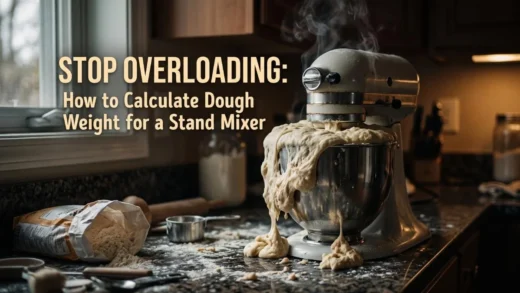
Knowing exactly how to calculate dough weight for a stand mixer is the absolute best way to prevent catastrophic motor failure and guarantee perfect bread every time. Whether you are scaling up a complex sourdough recipe or testing a new heavy pizza dough, throwing ingredients into the bowl without checking the total capacity against your machine’s limits is a costly mistake. This guide will walk you through the exact math to safely size your batches.
I use total dough weight to scale recipes, estimate how many loaves or pizza balls a batch will make, and compare a recipe with a mixer’s documented capacity. The important distinction is that manufacturers may specify total dough weight, flour weight, bowl volume or capacity for a particular dough formulation. These measurements are not interchangeable.
Use the calculator below to total your ingredients. Then check the manufacturer’s instructions for your exact mixer model before deciding whether the batch is suitable for kneading.
Dough Weight Calculator: How to Calculate Dough Weight for a Stand Mixer
Calculate your total dough weight and check it against your mixer’s documented capacity.
Use the same unit for every ingredient and the capacity limit.
1. Enter your ingredients
Enter the full starter weight here. If you use starter, do not count its flour and water a second time in these fields.
2. Compare with mixer capacity (optional)
Only enter a limit confirmed for your exact mixer model and dough type. This comparison is a calculation, not a safety certification.
3. Calculate dough from baker’s percentages
Enter the target dough weight and the total baker’s percentage, including flour at 100%.
The calculator should allow you to enter flour, water, salt, yeast and other ingredients, select a common weight unit, and calculate the total. If it includes a mixer-capacity comparison, it should let you specify whether the manufacturer’s limit refers to total dough weight or flour weight.
Remember that a recipe calculator estimates the weight of your ingredients. It does not determine the safe or recommended capacity of your mixer.
In this article, we’ll cover:
How to Calculate Dough Weight From a Recipe
The simplest method is to weigh each ingredient and add the values together.
Formula:
For a basic bread dough, this means adding the flour, water, salt and yeast. Include any oil, sugar, butter, seeds, grains, inclusions or other ingredients in the recipe.
Example: Calculate the total weight of bread dough
Suppose your recipe contains:
| Ingredient | Weight |
|---|---|
| Bread flour | 1,000 g |
| Water | 650 g |
| Salt | 20 g |
| Instant yeast | 10 g |
| Total dough weight | 1,680 g |
The calculation is:
The recipe makes approximately 1.68 kg of dough.
This is the ingredient weight before mixing. Small losses may occur when dough sticks to the bowl or equipment, and fermentation can cause minor mass changes. For planning a batch, however, adding the ingredient weights gives you the practical starting estimate.
What if the recipe uses cups instead of grams?
Convert each ingredient to a weight before adding the values together. A cup of flour does not necessarily weigh the same as a cup of water, and the weight of flour in a cup varies with the flour type and how it is measured.
For the most repeatable results, weigh ingredients in grams or ounces rather than relying on volume measurements. If a recipe only provides cups, use a reliable conversion specific to the ingredient and understand that the result is an estimate.
How to Calculate Dough Weight Using Baker’s Percentages
Baker’s percentages express each ingredient’s weight as a percentage of the flour weight. Flour is always treated as 100%, while the remaining ingredients are calculated relative to it.
For example, a dough with 65% water, 2% salt and 1% yeast has these percentages:
| Ingredient | Baker’s percentage |
|---|---|
| Flour | 100% |
| Water | 65% |
| Salt | 2% |
| Yeast | 1% |
| Total | 168% |
To calculate total dough weight from the flour weight, add all the ingredient percentages and multiply the flour weight by the resulting total percentage.
Where:
- = total dough weight
- = flour weight
- = total of all ingredient percentages
For example, if you use 1,000 g of flour:
The total dough weight is 1,680 g.
How to calculate flour weight from a target dough weight
You can also work backwards when you know how much dough you want to make.
Rearrange the formula:
Suppose you want 2,000 g of dough using the same formula, where the total baker’s percentage is 168%.
Your approximate ingredient weights would be:
| Ingredient | Calculation | Weight |
|---|---|---|
| Flour | 1,190.5 × 100% | 1,190.5 g |
| Water | 1,190.5 × 65% | 773.8 g |
| Salt | 1,190.5 × 2% | 23.8 g |
| Yeast | 1,190.5 × 1% | 11.9 g |
| Total | 2,000 g |
Small differences may occur because of rounding. For a practical recipe, round ingredient weights to sensible measuring increments and recalculate the actual total if precision matters.
How to Scale a Recipe to a Target Dough Weight
Recipe scaling lets you make a larger or smaller batch without changing the proportions of the ingredients.
Use this formula:
Then multiply every ingredient by that factor.
Example: Scale a recipe from 1.68 kg to 1.5 kg
The original recipe weighs 1,680 g, and your target is 1,500 g.
Multiply each original ingredient weight by approximately 0.8929.
| Ingredient | Original weight | Scaled weight |
|---|---|---|
| Flour | 1,000 g | 892.9 g |
| Water | 650 g | 580.4 g |
| Salt | 20 g | 17.9 g |
| Yeast | 10 g | 8.9 g |
| Total | 1,680 g | Approximately 1,500 g |
This method is useful when you want a batch that fits a smaller mixer, produces a specific number of loaves or pizza bases, or leaves room for another batch in your baking schedule.
Scaling the ingredients does not guarantee that the dough will behave identically in every mixer. Mixing efficiency, dough formulation and the manufacturer’s operating instructions still matter.
How Sourdough Starter Affects Dough Weight
Include the entire sourdough starter weight when calculating total dough weight. Starter contributes flour and water, and may also contain other ingredients depending on how it is maintained.
For example, if a recipe contains:
- 800 g flour added directly
- 500 g water added directly
- 200 g sourdough starter
- 18 g salt
Then the total dough weight is:
The dough weighs approximately 1.518 kg before mixing losses.
How to calculate the flour and water in a starter
If the starter is at 100% hydration, it contains equal weights of flour and water. A 200 g starter therefore contributes approximately 100 g flour and 100 g water.
For the example above, the effective ingredient totals are:
- Total flour: 800 + 100 = 900 g
- Total water: 500 + 100 = 600 g
- Salt: 18 g
- Starter: 200 g, already accounted for in the flour and water totals
The final dough weight is still 1,518 g. Do not add the full 200 g starter on top of the flour and water totals a second time, because that would double-count its ingredients.
For baker’s percentages and hydration calculations, account for the flour and water inside the starter. For total dough weight, count each physical ingredient only once.
Dough Weight vs. Flour Weight vs. Bowl Capacity
These terms describe different things. Confusing them can lead to an incorrect estimate of whether your mixer can handle a recipe.
| Measurement | What it means | How to use it |
|---|---|---|
| Total dough weight | Combined weight of all dough ingredients | Compare with a manufacturer’s stated maximum dough weight |
| Flour weight | Weight of the flour in the recipe | Compare only with a stated flour-weight limit |
| Bowl capacity | Volume the bowl can hold, often given in litres or quarts | Use as bowl-size information, not as a direct dough-weight rating |
| Dough hydration | Water weight expressed as a percentage of flour weight | Helps describe the dough formulation |
| Batch yield | Number or weight of loaves, rolls or pizza balls produced | Plan portions after calculating total dough weight |
A 2 kg dough batch is not the same as 2 kg of flour. If the dough contains 1,190 g flour and 810 g of other ingredients, its total weight is 2,000 g, but the flour weight is only 1,190 g.
Likewise, a 7-quart bowl does not automatically mean the mixer can knead a particular number of kilograms of dough. Bowl volume alone does not establish the manufacturer’s recommended dough limit.
Stand Mixer Dough Capacity Chart
There is no universal conversion from bowl size to dough capacity. A useful capacity chart should identify the exact mixer model, the type of capacity specified and any conditions attached to the rating.
The examples below show how to read manufacturer-published dough limits. They are not a substitute for checking the instructions for the model and region you own.
| Mixer | Manufacturer-published dough capacity | What to note |
|---|---|---|
| Ooni Halo Core spiral mixer | 500 g minimum to 2.5 kg maximum dough | The manufacturer distinguishes dough capacity from the capacity of its other mixing attachments. |
| Ooni Halo Pro spiral mixer | 1 kg minimum to 5 kg maximum dough | The manufacturer specifies a separate dough range for this model. |
Sources: Ooni Halo Core official product page and Ooni Halo Pro official product page.
These examples are manufacturer-published figures, not independent performance-test results. Confirm the current regional documentation before publication, and follow the instructions supplied with your own mixer.
How much dough can a 4.5-quart mixer make?
You cannot determine the maximum dough weight from the 4.5-quart label alone. Manufacturers use different bowl designs, mixing mechanisms and capacity-rating methods.
For example, the Ooni Halo Core has a bowl capacity listed as 4.5 litres on its metric product information and a maximum dough capacity of 2.5 kg. That rating belongs to this specific spiral mixer; it should not be transferred to another 4.5-quart planetary stand mixer.
Check the manual for your exact model. If the manufacturer gives a maximum flour weight rather than total dough weight, compare your recipe’s flour weight with that limit.
How much dough can a 7-quart mixer make?
A 7-quart bowl does not provide a universal dough-weight rating. Models with similarly sized bowls can have different motors, drive systems, dough hooks and manufacturer limits.
For example, the Ooni Halo Pro is listed with a 7-litre bowl and a maximum dough capacity of 5 kg. That is a model-specific manufacturer rating, not a rule for all mixers with a bowl around that size.
Use the exact product manual or official specifications rather than estimating capacity from bowl size.
How much dough can a 10-, 20- or 30-quart mixer make?
For commercial mixers, bowl capacity is especially insufficient as a standalone measure. Maximum batch size can vary with dough type, hydration, flour characteristics and the machine’s intended application.
For example, commercial mixer manuals may give separate limits for pizza dough and bread dough, even for the same machine. When a manufacturer publishes formulation-specific limits, use the limit that matches your recipe rather than one generic dough-weight figure.
If you are comparing commercial mixers, record the exact model, maximum total dough weight, dough formulation or absorption conditions, and any operating restrictions. Do not treat a capacity stated for one model as applicable to every mixer in the same quart class.
How to Check Whether a Batch Suits Your Mixer
Once you have calculated total dough weight, compare it with the correct manufacturer specification.
- Identify the exact mixer model. Check the model number on the appliance and make sure the documentation applies to that model and regional version.
- Find the dough-capacity statement. Look for a maximum total dough weight, flour-weight limit or formulation-specific capacity in the official manual or product documentation.
- Match the type of measurement. Compare total dough weight with a total-dough limit, or flour weight with a flour-weight limit. Do not compare one directly with the other.
- Check the dough conditions. Hydration, flour type and recipe formulation can affect the applicable limit. Follow any conditions in the manual.
- Check the minimum batch size if one is specified. Some mixers are designed to work within a particular minimum and maximum range.
- Follow the operating instructions. Use the specified attachment, speed and mixing procedure, and do not exceed the manufacturer’s stated limits.
If the documentation does not provide a clear dough limit, do not infer one from the bowl size or motor wattage. Consult the manufacturer before using an unusually large or stiff dough batch.
For more help choosing a suitable machine, see the stand mixer buying guide and best stand mixers for bread dough.
Frequently Asked Questions
What is a dough weight calculator?
A dough weight calculator totals the ingredient weights in a recipe. Depending on its features, it may also help scale a recipe, calculate flour requirements from a target dough weight or compare a batch with a manufacturer-stated limit. It cannot establish a mixer’s safe capacity without the relevant model-specific information.
How do I calculate dough weight from a recipe?
Add the weights of all ingredients, including flour, water, salt, yeast, starter and other additions. A recipe containing 1,000 g flour, 650 g water, 20 g salt and 10 g yeast makes approximately 1,680 g of dough.
Does dough increase in weight when it rises?
Dough generally increases in volume during fermentation because yeast and other microorganisms produce gas. Its mass does not increase in proportion to that volume. Small mass changes can occur through evaporation or gas exchange, but the main visible change is expansion rather than a comparable increase in weight.
Is 300W enough for a stand mixer?
Wattage alone is not enough to determine whether a stand mixer can knead your recipe. Motor design, gearing, mixing mechanism, dough formulation and the manufacturer’s stated capacity all matter. Choose a model with documented suitability for the quantity and type of dough you make.
Which stand mixer size is best for dough?
The right size depends on your typical batch weight, dough formulation, frequency of use and the manufacturer’s stated capacity. Calculate your usual total dough weight, then compare it with the exact model’s documented dough limit. Avoid choosing a mixer on bowl volume alone.
Should I compare dough weight or flour weight with my mixer’s capacity?
Compare like with like. If the manufacturer specifies maximum total dough weight, use the combined weight of all ingredients. If the manual specifies maximum flour weight, compare only the flour in your recipe with that figure. If the capacity depends on dough type or hydration, use the applicable condition.
How do I calculate the number of pizza dough balls a recipe makes?
Divide total dough weight by the target weight of each dough ball.
For example, 1,680 g of dough divided into 280 g portions gives six portions. If the result is not a whole number, adjust the portion weight or plan to use the remainder separately.
Does higher hydration mean I can make more dough in my mixer?
Not necessarily. Hydration describes the water weight relative to flour weight, but it does not by itself determine the maximum batch size. Follow the capacity conditions and recipe guidance provided for your particular mixer.
Final Takeaway
To calculate dough weight for a stand mixer, weigh and add every ingredient in the recipe. Use baker’s percentages when you need to calculate a target batch or scale a formula, and include the flour and water contained in sourdough starter without counting them twice.
Then check the manufacturer’s documentation for your exact mixer. Total dough weight, flour weight and bowl capacity are different measurements, and a calculated batch weight is not proof that a mixer can handle that batch safely or effectively.
For related guidance, read the stand mixer buying guide, stand mixers for bread dough and which dough hook fits my mixer.
Last Updated on October 21, 2026 by Susan Joy